
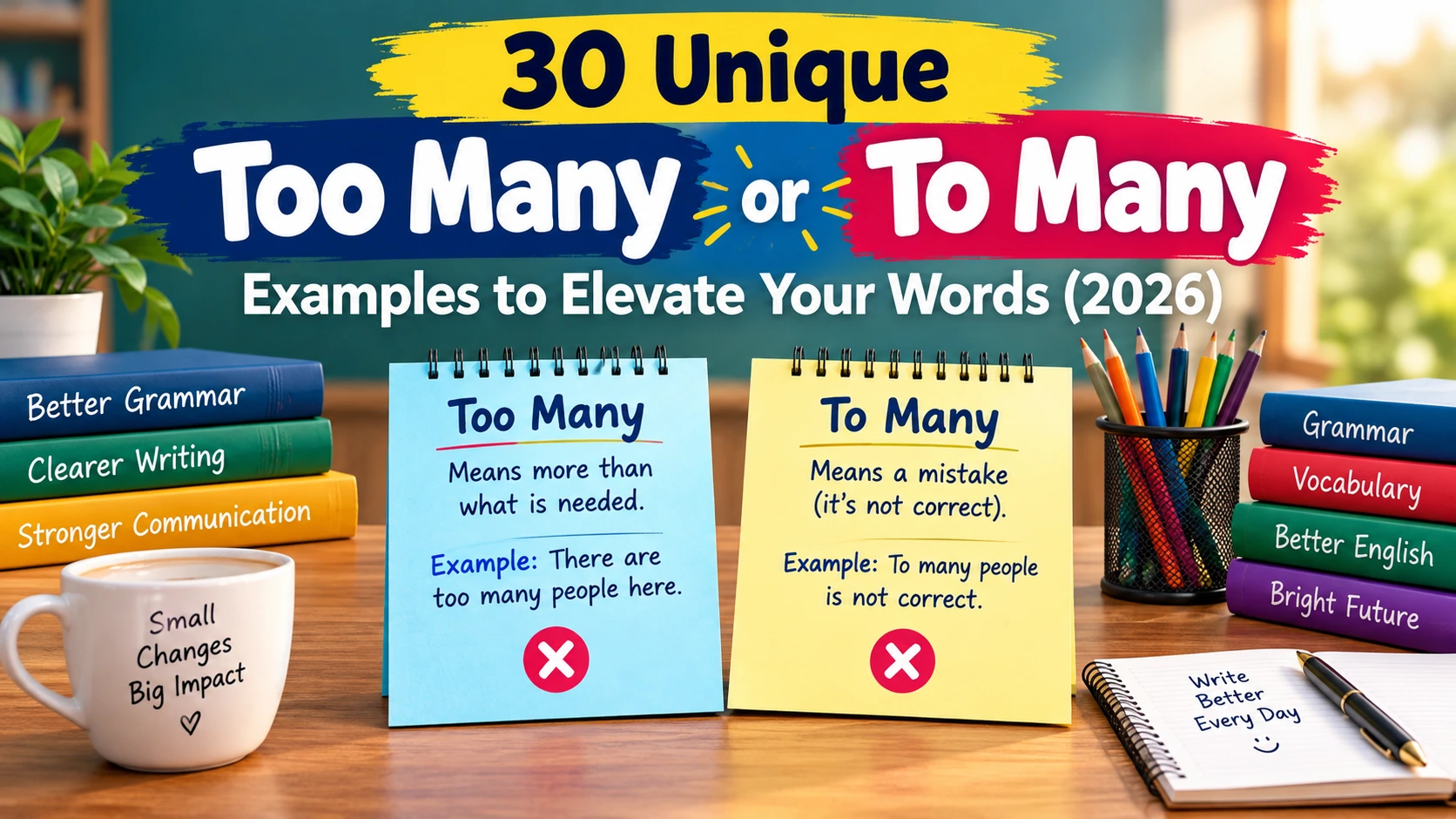
Choosing between too many and to many can be confusing because too and to sound alike but perform different jobs in English. In standard English, too many is the correct phrase when you mean an excessive number, while to many is normally incorrect when used to express quantity. This guide explains the difference, gives practical examples, and helps you avoid this common grammar mistake. (Cambridge Dictionary)
Definition of Too Many or Too Much
Too many is the correct phrase when you mean more people or things than are wanted, needed, or appropriate.
- Too means an excessive amount or number.
- Many is used with plural countable nouns.
- To usually expresses direction, relationship, or forms part of an infinitive verb.
- Therefore, too many does not normally mean “an excessive number.”
For example:
- There are too many cars on this road.
- She bought too many books.
- We invited too many people.
Cambridge Dictionary explains that too many is used before countable nouns when the quantity is more than enough. (Cambridge Dictionary)
What Is a Simile?
A simile is a figure of speech that compares two different things, usually with words such as like or as.
Although similes are useful in creative writing, they are different from the grammar issue of too many or too few. The focus of this article is correct word choice rather than figurative comparison.
Example
- Her smile was like sunshine.
- He ran as fast as a deer.
- The classroom was as quiet as a library.
Why Use Too Many or Too Much in Writing?
Understanding the difference helps you:
- Avoid common spelling and grammar errors.
- Make your writing easier to understand.
- Improve professional emails and documents.
- Write more accurately in school and academic work.
- Create cleaner website content.
- Improve confidence when proofreading.
- Distinguish quantity from direction or purpose.
- Communicate your intended meaning clearly.
The main rule is simple: use too many when you mean an excessive number of countable things. Oxford Learner’s Dictionaries gives the same pattern: too many + countable noun. (Oxford Learner’s Dictionaries)
Types of Too Many or To Many
The confusion usually comes from the different functions of too and to. You can understand the difference by looking at their main uses.
Too Many for Excessive Quantity
Use too many when something exists in a quantity greater than necessary, desirable, or manageable.
Example
- There are too many students in this classroom.
- I have too many tasks to finish today.
- She received too many messages this morning.
To for Direction or Destination
Use to when it shows movement toward a person, place, or destination.
Example
- We walked to the park.
- He sent the letter to his friend.
- She drove to the office.
To Before a Verb
Use to before the base form of a verb when forming an infinitive.
Example
- I want to learn English.
- They decided to leave early.
- She needs to study tonight.
Too for Also or As Well
Use too when you mean “also” or “as well.”
Example
- I want to come too.
- She likes coffee too.
- He finished the project too.
Writing Tips and Common Mistakes
Useful Tips
- Remember that too has an extra “o,” which can help you remember the idea of something extra or excessive.
- Use too many with plural countable nouns.
- Use too much with uncountable nouns.
- Use to for direction: “go to school.”
- Use to before a verb: “want to learn.”
- Read the complete sentence before choosing the word.
- Replace too with “excessively” or “also” as a quick test.
- Replace to with “toward” when it expresses direction.
- Proofread homophones carefully.
- Check whether the following noun can be counted.
Merriam-Webster defines too as an adverb that can indicate an excessive degree or mean “also.” (Merriam-Webster)
Common Mistakes to Avoid
- Incorrect: There are to many people here.
Correct: There are too many people here. - Incorrect: I have to many books.
Correct: I have too many books. - Incorrect: We have to go home.
Correct: We have to go home. - Incorrect: She went too the store.
Correct: She went to the store. - Do not use too many with an uncountable noun.
Incorrect: too many water
Correct: too much water - Do not automatically choose too because it sounds right. Check its meaning first.
30 Too Many or Too Much Examples
There Are Too Many People Here
Meaning: The number of people is greater than desired or manageable.
Detailed Explanation: Use too many because “people” is a plural countable noun, and the sentence describes an excessive number.
Tone: Neutral
Examples:
- There are too many people at the entrance.
- The restaurant has too many customers tonight.
- We should leave because there are too many people inside.
I Have Too Many Books
Meaning: You own or have more books than you need or can manage.
Detailed Explanation: “Books” is countable and plural, so too many correctly describes an excessive number.
Tone: Casual
Examples:
- I have too many books on my desk.
- She says I have too many books already.
- We need another shelf because I have too many books.
She Asked Too Many Questions
Meaning: She asked more questions than necessary.
Detailed Explanation: “Questions” can be counted, so too many is grammatically appropriate.
Tone: Neutral
Examples:
- She asked too many questions during the meeting.
- The interviewer asked too many questions.
- He felt uncomfortable because she asked too many questions.
We Made Too Many Mistakes
Meaning: The number of mistakes was excessive.
Detailed Explanation: “Mistakes” is a plural countable noun, making too many the correct choice.
Tone: Reflective
Examples:
- We made too many mistakes in the first draft.
- The team made too many mistakes during the match.
- We should review our work because we made too many mistakes.
There Are Too Many Cars
Meaning: The road contains more cars than it can comfortably handle.
Detailed Explanation: “Cars” is a plural countable noun, so too many expresses excessive quantity.
Tone: Concerned
Examples:
- There are too many cars on this street.
- The city has too many cars during rush hour.
- We waited because there were too many cars ahead.
He Has Too Many Responsibilities
Meaning: He has more duties than he can reasonably manage.
Detailed Explanation: “Responsibilities” is a plural countable noun, so too many is correct.
Tone: Serious
Examples:
- He has too many responsibilities at work.
- She thinks he has too many responsibilities.
- Managing too many responsibilities can become stressful.
They Bought Too Many Tickets
Meaning: They purchased more tickets than they needed.
Detailed Explanation: “Tickets” is plural and countable, so too many correctly describes the excessive number.
Tone: Casual
Examples:
- They bought too many tickets for the event.
- We accidentally ordered too many tickets.
- The group realized they had too many tickets.
There Are Too Many Rules
Meaning: The number of rules is greater than necessary.
Detailed Explanation: “Rules” is a plural countable noun, so use too many.
Tone: Critical
Examples:
- This school has too many rules.
- The game has too many rules to remember.
- Employees complained about too many rules.
I Received Too Many Emails
Meaning: You received an excessive number of emails.
Detailed Explanation: “Emails” is countable and plural, so too many is the correct expression.
Tone: Professional
Examples:
- I received too many emails this morning.
- The customer received too many emails.
- We need a better system because we receive too many emails.
She Owns Too Many Shoes
Meaning: She has more shoes than she needs.
Detailed Explanation: “Shoes” is a plural countable noun, so too many correctly describes the quantity.
Tone: Humorous
Examples:
- She owns too many shoes.
- My sister says I have too many shoes.
- She joked that nobody can own too many shoes.
We Have Too Many Meetings
Meaning: The number of meetings is excessive.
Detailed Explanation: “Meetings” is a plural countable noun, so too many is correct.
Tone: Professional
Examples:
- We have too many meetings every week.
- The team canceled some meetings because there were too many.
- Employees said they attend too many meetings.
There Are Too Many Notifications
Meaning: The number of notifications is excessive.
Detailed Explanation: “Notifications” is countable and plural, making too many the appropriate phrase.
Tone: Casual
Examples:
- My phone receives too many notifications.
- I turned off the app because it sent too many notifications.
- There are too many notifications on my screen.
He Has Too Many Ideas
Meaning: He has more ideas than he can reasonably develop.
Detailed Explanation: “Ideas” is a plural countable noun, so too many indicates an excessive number.
Tone: Creative
Examples:
- He has too many ideas for one project.
- The writer has too many ideas for a single story.
- She keeps a notebook because she has too many ideas.
We Asked Too Many Questions
Meaning: We asked more questions than necessary.
Detailed Explanation: “Questions” is countable and plural, so too many is correct.
Tone: Reflective
Examples:
- We asked too many questions during the interview.
- Perhaps we asked too many questions at once.
- The students asked too many questions before the test.
The Store Has Too Many Customers
Meaning: The store has an excessive number of customers.
Detailed Explanation: “Customers” is a plural countable noun, so use too many.
Tone: Neutral
Examples:
- The store has too many customers today.
- We left because the store had too many customers.
- The manager called for help because there were too many customers.
She Made Too Many Changes
Meaning: She changed more things than necessary.
Detailed Explanation: “Changes” is countable and plural, so too many correctly expresses excessive quantity.
Tone: Constructive
Examples:
- She made too many changes to the design.
- The editor said the writer made too many changes.
- We should avoid making too many changes at once.
There Are Too Many Options
Meaning: There are more choices than are useful or manageable.
Detailed Explanation: “Options” is a plural countable noun, so too many is correct.
Tone: Thoughtful
Examples:
- There are too many options on the menu.
- The website gives users too many options.
- Choosing becomes difficult when there are too many options.
I Have Too Many Tasks
Meaning: You have more tasks than you can comfortably complete.
Detailed Explanation: “Tasks” is plural and countable, so too many accurately describes the quantity.
Tone: Serious
Examples:
- I have too many tasks to finish today.
- She postponed the project because she had too many tasks.
- We need help because we have too many tasks.
They Invited Too Many Guests
Meaning: They invited more guests than appropriate or manageable.
Detailed Explanation: “Guests” is a plural countable noun, so too many is the correct phrase.
Tone: Neutral
Examples:
- They invited too many guests to the small room.
- We realized that we had invited too many guests.
- The host worried about having too many guests.
There Are Too Many Problems
Meaning: The number of problems is excessive.
Detailed Explanation: “Problems” is a plural countable noun, so too many correctly expresses an excessive number.
Tone: Serious
Examples:
- There are too many problems with this plan.
- The project has too many problems to ignore.
- We need a new strategy because there are too many problems.
He Has Too Many Apps
Meaning: He has more applications than he needs.
Detailed Explanation: “Apps” is a plural countable noun, so too many is grammatically correct.
Tone: Casual
Examples:
- He has too many apps on his phone.
- I deleted some because I had too many apps.
- Her phone became slow because she installed too many apps.
We Saw Too Many Advertisements
Meaning: We saw an excessive number of advertisements.
Detailed Explanation: “Advertisements” is plural and countable, so too many is the correct choice.
Tone: Critical
Examples:
- We saw too many advertisements during the video.
- The website displayed too many advertisements.
- Customers complained about seeing too many advertisements.
The Class Has Too Many Students
Meaning: The class contains more students than is ideal.
Detailed Explanation: “Students” is a plural countable noun, so too many correctly describes the number.
Tone: Academic
Examples:
- The class has too many students.
- The teacher struggles because there are too many students.
- The school needs another classroom because there are too many students.
She Collected Too Many Pictures
Meaning: She collected more pictures than necessary or manageable.
Detailed Explanation: “Pictures” is plural and countable, making too many the correct expression.
Tone: Casual
Examples:
- She collected too many pictures from the trip.
- I saved too many pictures on my computer.
- He deleted some files because he had too many pictures.
There Are Too Many Messages
Meaning: There are more messages than someone wants or can handle.
Detailed Explanation: “Messages” is a plural countable noun, so too many is correct.
Tone: Casual
Examples:
- There are too many messages in my inbox.
- She received too many messages overnight.
- I cannot answer because there are too many messages.
We Have Too Many Plans
Meaning: We have more plans than we can realistically complete.
Detailed Explanation: “Plans” is countable and plural, so too many correctly shows excessive quantity.
Tone: Friendly
Examples:
- We have too many plans for one weekend.
- They made too many plans for a single day.
- We should simplify things because we have too many plans.
He Asked Too Many Favors
Meaning: He requested an excessive number of favors.
Detailed Explanation: “Favors” is a plural countable noun, so too many is grammatically correct.
Tone: Critical
Examples:
- He asked too many favors from his coworkers.
- She felt uncomfortable because he asked for too many favors.
- You should not ask too many favors from one person.
The Website Has Too Many Pages
Meaning: The website contains more pages than necessary or convenient.
Detailed Explanation: “Pages” is plural and countable, so too many correctly expresses an excessive number.
Tone: Professional
Examples:
- The website has too many pages.
- Visitors may feel confused by too many pages.
- We should combine some sections because the site has too many pages.
There Are Too Many Choices
Meaning: There are more choices than a person can easily consider.
Detailed Explanation: “Choices” is a plural countable noun, so too many is correct.
Tone: Thoughtful
Examples:
- There are too many choices on the menu.
- Customers may feel overwhelmed by too many choices.
- We reduced the list because there were too many choices.
I Made Too Many Changes
Meaning: I changed more things than necessary.
Detailed Explanation: “Changes” is countable and plural, so too many is the correct expression.
Tone: Reflective
Examples:
- I made too many changes to the original design.
- The editor said I made too many changes.
- I learned that making too many changes can create new problems.
She Has Too Many Responsibilities
Meaning: She has more duties than she can reasonably manage.
Detailed Explanation: “Responsibilities” is a plural countable noun, so too many is grammatically correct.
Tone: Serious
Examples:
- She has too many responsibilities at work.
- Her manager noticed that she had too many responsibilities.
- Sharing the workload can help when someone has too many responsibilities.
Top 10 Too Many or Too Much
| Simile | Meaning | Tone |
| Too many people | More people than desired or manageable | Neutral |
| Too many books | More books than needed | Casual |
| Too many questions | More questions than necessary | Neutral |
| Too many mistakes | An excessive number of errors | Reflective |
| Too many cars | More cars than the road can comfortably handle | Concerned |
| Too many responsibilities | More duties than someone can reasonably manage | Serious |
| Too many emails | An excessive number of emails | Professional |
| Too many meetings | More meetings than necessary or useful | Professional |
| Too many options | More choices than someone can easily manage | Thoughtful |
| Too many choices | An excessive number of alternatives | Thoughtful |
Quick Rule: Too Many vs. To Many
The easiest rule is:
Use “too many” for excessive numbers.
- too many books
- too many students
- too many questions
- too many problems
Use “to” for direction or before a verb.
- go to school
- walk to work
- want to learn
- need to study
The two words sound alike, but their meanings and grammatical functions differ. Too can mean “also” or indicate excess, while to commonly works as a preposition or infinitive marker. (Merriam-Webster)
Final Takeaway
When you mean more than necessary or wanted, choose too many, not to many. The word too expresses excess, while many works with plural countable nouns. By contrast, to commonly shows direction or appears before a verb. Remembering this simple distinction will help you write clearer, more accurate English in everyday, academic, and professional situations. (Cambridge Dictionary)
If you still find too many or too much confusing, this second part gives you more practical examples and simple ways to remember the correct form. The key rule remains straightforward: use too many when you mean an excessive number of people or things. Use too for direction, connection, or before a verb. These examples will help you recognize the difference naturally.
More Examples of Too Many
Too Many Words
Meaning: More words than necessary.
Detailed Explanation: Use too many because “words” is a plural countable noun.
Tone: Practical
Examples:
- This sentence contains too many words.
- The article uses too many words in one paragraph.
- Try removing too many unnecessary words.
Too Many Photos
Meaning: More photos than needed or manageable.
Detailed Explanation: “Photos” can be counted, so too many correctly expresses an excessive number.
Tone: Casual
Examples:
- I took too many photos during the vacation.
- My phone contains too many photos.
- She uploaded too many photos at once.
Too Many Questions
Meaning: An excessive number of questions.
Detailed Explanation: “Questions” is plural and countable, so too many is correct.
Tone: Neutral
Examples:
- The student asked too many questions.
- We received too many questions from readers.
- Asking too many questions can delay the meeting.
Too Many Notifications
Meaning: More notifications than someone wants to receive.
Detailed Explanation: Since “notifications” are countable, use too many.
Tone: Casual
Examples:
- My phone sends too many notifications.
- I disabled the app because it produced too many notifications.
- She became annoyed by too many notifications.
Too Many Ideas
Meaning: More ideas than someone can develop or organize.
Detailed Explanation: “Ideas” is a plural countable noun, so too many fits correctly.
Tone: Creative
Examples:
- The writer has too many ideas for one article.
- I have too many ideas for a single project.
- He keeps notes because he has too many ideas.
When to Use To
To School
Meaning: Moving toward or going to a school.
Detailed Explanation: Here, to expresses direction or destination.
Tone: Everyday
Examples:
- The children walk to school.
- She went to school early.
- He takes the bus to school.
To Work
Meaning: Going toward a workplace.
Detailed Explanation: To show movement toward a destination.
Tone: Everyday
Examples:
- I drive to work every morning.
- She walked to work yesterday.
- They arrived at work before everyone else.
To Learn
Meaning: Used before the verb “learn.”
Detailed Explanation: Forms an infinitive with the base verb “learn.”
Tone: Educational
Examples:
- I want to learn English.
- She needs to learn grammar.
- They decided to learn together.
To Improve
Meaning: Used before the verb “improve.”
Detailed Explanation: To introduce the infinitive verb “improve.”
Tone: Professional
Examples:
- I want to improve my writing.
- She works hard to improve her skills.
- We need to improve the website.
To Help
Meaning: Used before the verb “help.”
Detailed Explanation: It works as an infinitive marker before “help.”
Tone: Helpful
Examples:
- I came to help you.
- She stayed late to help her team.
- He offered to help with the project.
Too Can Also Mean “Also”
One reason learners confuse too and to is that too has more than one use. It can describe excess, but it can also mean also or as well.
Examples:
- I want to come too.
- She likes English too.
- He is coming with us too.
- I enjoyed the movie too.
A useful test is to replace too with “also.” If the sentence still makes sense, too may mean “also.”
Too Many vs. Too Much
Do not confuse too many with too much.
Use too many with plural countable nouns:
- too many books
- too many students
- too many emails
- too many cars
- too many questions
Use too much with uncountable nouns:
- too much water
- too much time
- too much money
- too much information
- too much work
Incorrect and Correct Examples
- ❌ There are too much books.
- ✅ There are too many books.
- ❌ I have too many money.
- ✅ I have too much money.
- ❌ She drank too many water.
- ✅ She drank too much water.
- ❌ We have too much meetings.
- ✅ We have too many meetings.
Common Too Many or To Many Questions
Is “too many” correct?
Yes. Too many is correct when you mean an excessive number of plural countable nouns.
Is “to many” ever correct?
Yes, but usually not as a fixed phrase meaning “an excessive number.” The words may appear next to each other when to has another grammatical function.
For example:
- The information was available to many students.
Here, to is a preposition and many refers to a large number of students.
Which is correct: “too many people” or “to many people”?
Too many people is correct when you mean an excessive number of people.
Example:
- There are too many people in the room.
Which is correct: “too many things” or “to many things”?
Use too many things when you mean an excessive number of things.
Example:
- I have too many things to do today.
Is “too many” one word?
No. Too many consists of two separate words.
What is the easiest way to remember “too”?
Think of the extra o as meaning extra.
- too many = an extra or excessive number
- too much = an extra or excessive amount
Quick Practice
Choose too, to, or too many in each sentence.
- There are ___ people in the room.
- I want ___ learn English.
- She went ___ the store.
- He has ___ books.
- I want ___ come with you.
- We have ___ questions.
- They need ___ study harder.
- There are ___ cars on the road.
- She likes coffee ___.
- He has ___ responsibilities.
Answers
- too many
- to
- to
- too many
- to
- too many
- to
- too many
- too
- too many
Final Reminder
Remember these three simple rules:
- Too many = an excessive number.
- To = direction, connection, or infinitive marker.
- Too = excessive or “also.”
Once you understand the function of each word, choosing between too many or to many becomes much easier. When you want to say that there is an excessive number of people or things, always choose too many.
Conclusion :
Understanding Too Many or Too Much becomes much easier once you focus on the meaning and grammatical role of each word. In most sentences where you want to describe an excessive number of people or things, too many is the correct choice. For example, “There are too many books on the table” clearly shows that the number of books is more than needed
. On the other hand, to usually shows direction, connection, or appears before a verb, as in “go to school” or “to learn.” Remember that too can also mean “also,” which gives it another important use. By practicing these simple distinctions, you can avoid one of the most common English grammar and spelling mistakes. Whether you are writing an email, school assignment, blog post, or everyday message, choosing the right form will make your writing clearer, smoother, and more professional.
FAQs
Is “too many” or “to many” correct?
Too many is correct when you mean an excessive number of people or things. For example, “There are too many students in the classroom.” The word too expresses excess, while many describes a plural countable noun. Too many can appear when “to” has its normal grammatical function, but it does not normally mean “an excessive number.”
What does “too many” mean?
Too many means more people or things than are needed, wanted, suitable, or manageable. For example, “I have too many emails” means the number of emails is excessive. It is used with plural countable nouns such as books, cars, questions, people, and students. This makes too many different from too much, which applies to uncountable nouns.
What is the difference between “too” and “to”?
Too commonly means “more than necessary” or “also,” while to commonly shows direction or introduces an infinitive verb. For example, “There are too many chairs” expresses excess, while “She went to school” expresses direction. In “I want to learn,” to introduces the verb “learn.” Their pronunciation may sound similar, but their grammatical functions differ.
Is “to many” grammatically correct?
To many can be grammatically correct when to serves another purpose in a sentence. For example, “This rule is confusing to many students” is correct because to connects “confusing” with “many students.” However, if you want to say that something exists in an excessive number, use too many, as in “There are too many students here.”
When should I use “too many”?
Use too many when you want to describe an excessive number of plural countable nouns. Examples include “too many books,” “too many people,” “too many questions,” and “too many mistakes.” A helpful test is to ask whether you mean “more than necessary.” If the answer is yes, too many is usually the correct expression.
Can “too many” be used with singular nouns?
No. Too many normally comes before plural countable nouns. For example, say “too many books,” not “too many book.” When discussing an uncountable noun, use too much, such as “too much water” or “too much information.” Choosing between many and much depends on whether the noun can be counted individually.
What is the difference between “too many” and “too much”?
Use too many with plural countable nouns and too much with uncountable nouns. For example, “too many apples” is correct because apples can be counted. “Too much water” is correct because water is normally uncountable. Both expressions indicate an excessive amount or quantity, but the noun determines which form you should use.
How can I remember “too many”?
A simple memory trick is to connect the extra o in too with the idea of something extra. Too many means an extra or excessive number. For example, “too many cookies” means more cookies than needed. This small reminder can help you quickly choose too many when writing or proofreading sentences.
Why do people confuse “too many” and “to many”?
People often confuse these expressions because too and to sound alike in everyday speech. They are homophones, meaning they have the same or very similar pronunciation but different meanings and uses. Careful writers should focus on the meaning of the sentence. If the sentence describes an excessive number, too many is the appropriate choice.
What is the easiest way to learn “too many or too much”?
Start by remembering one main rule: too many describes an excessive number. Then practice identifying whether the noun is plural and countable. For example, “too many books” and “too many students” are correct. Use to when showing direction or before a verb, such as “go to school” or “to study.” Regular practice makes the distinction natural.
Meta Description
Too Many or To Many explained simply: learn the correct usage, key grammar rules, examples, and easy tips to avoid this common mistake.