
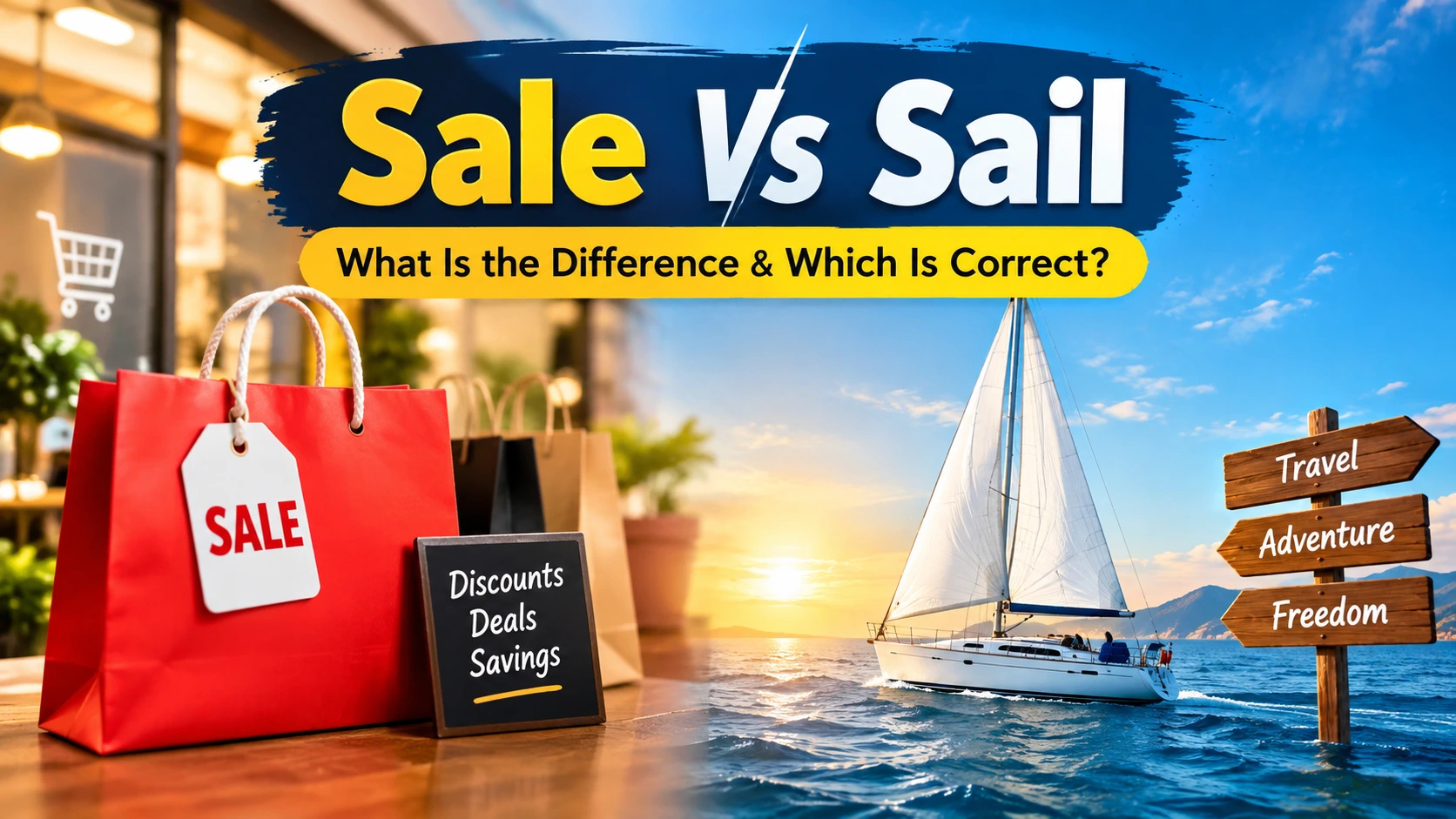
Many English learners confuse sale and sail because they sound the same. However, these two words have completely different meanings and are used in different situations. Understanding the difference between sale vs. sail will help you avoid common writing mistakes and communicate more accurately in both speaking and writing.
Comparison Overview
Although sale and sail are homophones (words that sound alike but have different meanings and spellings), they are unrelated in meaning.
| Feature | Sale | Sail |
| Part of Speech | Noun | Noun, Verb |
| Main Meaning | The exchange of goods or services for money | A piece of fabric that catches wind or the act of traveling by boat |
| Common Context | Shopping, business, marketing | Boating, ships, travel, sports |
| Pronunciation | /seɪl/ | /seɪl/ |
| Common Confusion | Mistaken because it sounds like “sail” | Mistaken because it sounds like “sale” |
Definition of Sale
A sale is the act of selling something or an event where products or services are offered for purchase, often at reduced prices.
As a noun, it refers to a business transaction or a promotional event.
Examples
- The store is having a holiday sale.
- Car sales increased this year.
- The house is for sale.
- The company celebrated a record sale.
- I bought these shoes during a clearance sale.
Definition of Sail
Sail can be both a noun and a verb.
As a noun, it refers to the large piece of fabric attached to a boat that catches the wind.
As a verb, it means to travel across water using a boat or ship.
Examples
- The boat raised its sail.
- We will sail across the lake tomorrow.
- They sailed to another island.
- The wind filled the sails.
- She loves to sail during summer.
Main Differences Between Sale and Sail
| Feature | Sale | Sail |
| Meaning | Selling goods or services | Traveling on water or boat equipment |
| Part of Speech | Noun | Noun and Verb |
| Related To | Business, shopping | Boats, ships, water travel |
| Can Be a Verb? | No | Yes |
| Example | Winter sale starts Friday. | They sail every weekend. |
Key Differences
- Sale always relates to buying or selling.
- Sail relates to boats, ships, or traveling on water.
- Sale is only a noun.
- Sail functions as both a noun and a verb.
- They are pronounced the same but spelled differently.
Why Are Sale and Sail Confused?
The confusion happens because they are homophones. They have identical pronunciation but completely different meanings.
For example:
- ❌ The boat is on sale across the lake.
- ✅ The boat will sail across the lake.
- ❌ The department store announced a summer sail.
- ✅ The department store announced a summer sale.
Comparison Table
| Question | Use Sale | Use Sail |
| Talking about discounts | ✔ | ✘ |
| Referring to shopping | ✔ | ✘ |
| Talking about boats | ✘ | ✔ |
| Referring to ocean travel | ✘ | ✔ |
| Discussing business transactions | ✔ | ✘ |
Grammar Guide
How each term is used in sentences
Sale
Pattern:
Subject + be + on sale
Examples:
- The books are on sale.
- This laptop is on sale today.
Pattern:
Sale + of + object
Examples:
- The sale of the property took months.
- The sale of tickets begins Monday.
Sail
As a verb:
Subject + sail + destination
Examples:
- We sail every weekend.
- They sailed across the river.
As a noun:
The sail + verb
Examples:
- The sail caught the wind.
- The white sail looked beautiful.
Common mistakes learners make
- Writing sale instead of sail when discussing boats.
- Using sail instead of sale for shopping discounts.
- Forgetting that sale cannot be used as a verb.
- Assuming both words have related meanings.
- Choosing the wrong spelling because they sound identical.
Simple rules to remember
- Think Sale = Sell.
- Think Sail = Ship.
- If money or shopping is involved, choose sale.
- If boats or oceans are involved, choose sail.
- Remember that only sail can be used as a verb.
Quick tips for writing and speaking
- Read the sentence carefully for context.
- Ask yourself whether the topic is shopping or boating.
- Remember that pronunciation cannot help because both sound the same.
- Proofread homophones carefully.
- Learn example sentences for each word.
When to Use Each One
Use Sale when:
- Talking about discounts.
- Discussing retail stores.
- Referring to business transactions.
- Selling property.
- Mentioning marketing promotions.
Use Sail when:
- Talking about boats.
- Describing sea travel.
- Discussing sailing sports.
- Referring to ship equipment.
- Talking about ocean adventures.
When NOT to Use Each One
Do NOT use Sale when:
- Talking about boats.
- Referring to sea travel.
- Describing wind-powered movement.
- Discussing sailing competitions.
- Talking about ship equipment.
Do NOT use Sail when:
- Talking about shopping discounts.
- Discussing business revenue.
- Referring to retail promotions.
- Mentioning products for purchase.
- Talking about property transactions.
Which One to Use (Decision Guide)
Use this simple guide:
- Are you discussing shopping, discounts, or selling something?
→ Sale - Are you discussing boats, ships, oceans, or water travel?
→ Sail - Is the word functioning as a verb?
→ Sail - Is it referring to a promotional event?
→ Sale
Real-World Practical Examples
Sale Examples
- The electronics store announced a weekend sale.
- Our school organized a charity bake sale.
- The apartment is now for sale.
- Online sales increased after the advertisement.
- The business reported record holiday sales.
Sail Examples
- We will sail across the bay tomorrow.
- The captain repaired the damaged sail.
- They sailed around the island.
- Strong winds helped the boat sail faster.
- Learning to sail requires practice and patience.
Self-Assessment (Fill in the Blanks)
- I will use ______ when referring to discounted products. The correct word is ______ because it relates to shopping.
- I will use ______ when talking about traveling by boat. The correct word is ______ because it refers to water travel.
- The furniture is on ______ today. The correct word is ______ because it means discounted.
- They will ______ across the lake. The correct word is ______ because it is a verb.
- The summer ______ attracted many customers. The correct word is ______ because it refers to a shopping event.
- The yacht raised its ______. The correct word is ______ because it is part of a boat.
- The company celebrated a successful ______. The correct word is ______ because it means a business transaction.
- We learned to ______ during vacation. The correct word is ______ because it means travel by boat.
- The clothing ______ starts tomorrow. The correct word is ______ because it refers to discounts.
- The fisherman repaired the ______. The correct word is ______ because it is boat equipment.
- Our school held a book ______. The correct word is ______ because books were sold.
- The family will ______ around the islands. The correct word is ______ because they are traveling by boat.
- Every product is on ______. The correct word is ______ because it relates to shopping.
- The wind filled the boat’s ______. The correct word is ______ because it catches the wind.
- The property ______ was completed yesterday. The correct word is ______ because ownership was transferred.
- They love to ______ on weekends. The correct word is ______ because it is a boating activity.
- The shoe ______ ends tonight. The correct word is ______ because it is a promotion.
- We watched ships ______ into the harbor. The correct word is ______ because it describes movement on water.
- Black Friday ______ attract huge crowds. The correct word is ______ because they are shopping events.
- Birds seemed to ______ across the lake like boats. The correct word is ______ because it describes smooth movement similar to boating.
Answers
- sale, sale
- sail, sail
- sale, sale
- sail, sail
- sale, sale
- sail, sail
- sale, sale
- sail, sail
- sale, sale
- sail, sail
- sale, sale
- sail, sail
- sale, sale
- sail, sail
- sale, sale
- sail, sail
- sale, sale
- sail, sail
- sales, sales
- sail, sail
Final Verdict
Although sale and sail are pronounced the same, they have entirely different meanings and uses. Sale is always associated with buying, selling, discounts, and business transactions, while sail relates to boats, ships, wind-powered movement, or traveling on water. A simple way to remember the difference is that sale connects with sell, and sail connects with sea. Paying attention to the context of your sentence is the easiest way to choose the correct word. Once you understand these distinctions, you’ll be able to use sale and sail confidently in everyday conversations, academic writing, business communication, and professional documents without confusion.
Conclusion:
Understanding the difference between sale vs. sail is easier once you know the context in which each word is used. Although they sound the same, sale refers to buying and selling goods or services, while sail relates to boats, ships, or traveling on water. Since they are homophones, they can easily be confused in writing, but paying attention to the meaning of your sentence will help you choose the correct spelling every time.
Whether you’re writing an email, preparing schoolwork, creating business content, or simply improving your English skills, knowing when to use sale and sail will make your communication clearer and more professional. By remembering that sale belongs to shopping and business, while sail belongs to boating and sea travel, you’ll avoid common mistakes and write with greater confidence. With regular practice and real-world examples, using these words correctly will soon become second nature.
FAQs
What is the difference between sale and sail?
Sale is a noun that refers to selling products or services or a shopping event with discounts. Sail is a noun or a verb related to boats, ships, or traveling on water. Although they sound alike, their meanings and uses are completely different.
Are sale and sail pronounced the same?
Yes, sale and sail are pronounced the same. They are homophones, which means they share the same pronunciation but have different spellings and meanings. This is why many English learners confuse them when writing.
Is sale a verb?
No, sale is only a noun. It describes the act of selling, a business transaction, or a promotional event where items are offered for purchase. If you want to describe the action, you should use the verb sell, not sale.
Can sail be both a noun and a verb?
Yes. As a noun, sail refers to the fabric attached to a boat that catches the wind. As a verb, it means to travel across water using a boat or ship. The intended meaning depends on the sentence.
When should I use sale?
Use sale whenever you are talking about shopping, discounts, retail promotions, business transactions, or selling property and products. If money, customers, or commerce is involved, sale is usually the correct word.
When should I use sail?
Use sail when referring to boats, ships, sailing activities, or traveling on water. It is also correct when describing the movement of a vessel or the sail attached to a boat that catches the wind.
Why do people confuse sale and sail?
People confuse sale and sail because they sound identical when spoken. Since English has many homophones, it is important to rely on the meaning and context of the sentence rather than pronunciation alone.
How can I remember the difference between sale and sail?
A simple trick is to connect sale with sell because both relate to shopping and business. Connect sail with the sea because both are associated with boats and water travel. These word associations make remembering easier.
Are sale and sail interchangeable?
No, they are never interchangeable. Even though they have the same pronunciation, replacing one with the other changes the meaning of the sentence and results in incorrect grammar and confusing communication.
Is learning the difference between sale and sail important?
Yes. Understanding the difference helps you write more accurately, avoid spelling mistakes, and communicate clearly in school, work, business, and everyday conversations. Correct word choice also improves the overall quality and professionalism of your writing.
Meta Description:
Learn the difference between Sale Vs Sail with simple meanings, grammar, examples, and usage tips to choose the correct word confidently.