
“Could” and “can” are modal verbs that express ability, possibility, and permission, but they serve different purposes depending on the context. Understanding the difference between could and can helps you communicate more clearly in everyday conversations, professional writing, and academic work. Although both words are often correct, choosing the right one depends on the time, meaning, and tone of your sentence.
Comparison Overview
“Can” and “could” are both modal verbs that work with the base form of another verb. However, they differ in how they express ability, possibility, permission, and polite requests.
- Can generally describes present ability, current possibility, informal permission, or direct requests.
- Could often describes past ability, a possible situation, a suggestion, or a more polite request.
For example:
- Can: I can speak English fluently.
- Could: I could speak a little English when I was five.
- Can: Can I borrow your pen?
- Could: Could I borrow your pen?
Both words are grammatically correct in these examples, but they communicate slightly different meanings or levels of politeness.
Definition of Can
Can is a modal auxiliary verb used to express present ability, possibility, permission, and willingness in certain contexts. It helps describe what someone is able to do, what may happen, or what someone is allowed to do.
Unlike regular verbs, “can” does not change its form according to the subject. You use “can” with I, you, he, she, it, we, and they.
Examples of Can
- I can swim across the pool.
- She can solve difficult math problems.
- We can finish this project today.
- Can I use your phone?
- Anyone can make a mistake.
In each sentence, “can” expresses an ability, possibility, or request for permission.
When Can Expresses Ability
Use “can” when someone has the skill or ability to do something in the present.
Examples:
- He can drive a car.
- My sister can play the piano.
- They can understand Spanish.
When Can Expresses Possibility
Use “can” to describe something that is possible or sometimes happens.
Examples:
- Heavy rain can cause flooding.
- Learning a new language can be challenging.
- Mistakes can happen when people rush.
When Can Expresses Permission
Use “can” to ask for or give permission, particularly in everyday conversations.
Examples:
- Can I sit here?
- You can leave early today.
- Can we enter the building now?
Definition of Could
Could is a modal auxiliary verb used to express past ability, possibility, polite requests, suggestions, and hypothetical situations. It is often considered a more polite alternative to “can” when asking someone to do something.
Like “can,” “could” stays the same regardless of the subject and is followed by the base form of a verb.
Examples of Could
- I could run faster when I was younger.
- She could be at home right now.
- Could you help me with this assignment?
- We could visit the museum tomorrow.
- If I had more time, I could learn another language.
These examples demonstrate how “could” changes meaning according to context.
When Could Expresses Past Ability
Use “could” to describe a general ability someone possessed in the past.
Examples:
- I could read simple books at the age of four.
- My grandfather could speak three languages.
- She could run long distances when she was younger.
For a specific successful action on one occasion, English often uses “was able to” or “managed to” instead of “could.”
For example:
- I was able to solve the problem yesterday.
- I managed to catch the last bus.
When Could Expresses Possibility
Use “could” when something is possible but uncertain.
Examples:
- It could rain this evening.
- This information could be useful later.
- The missing keys could be in the kitchen.
When Could Expresses Polite Requests
Use “could” to make requests sound more courteous, especially in formal situations or when speaking to someone you do not know well.
Examples:
- Could you explain this rule?
- Could you please send me the report?
- Could I ask you a question?
Main Differences Between Could and Can
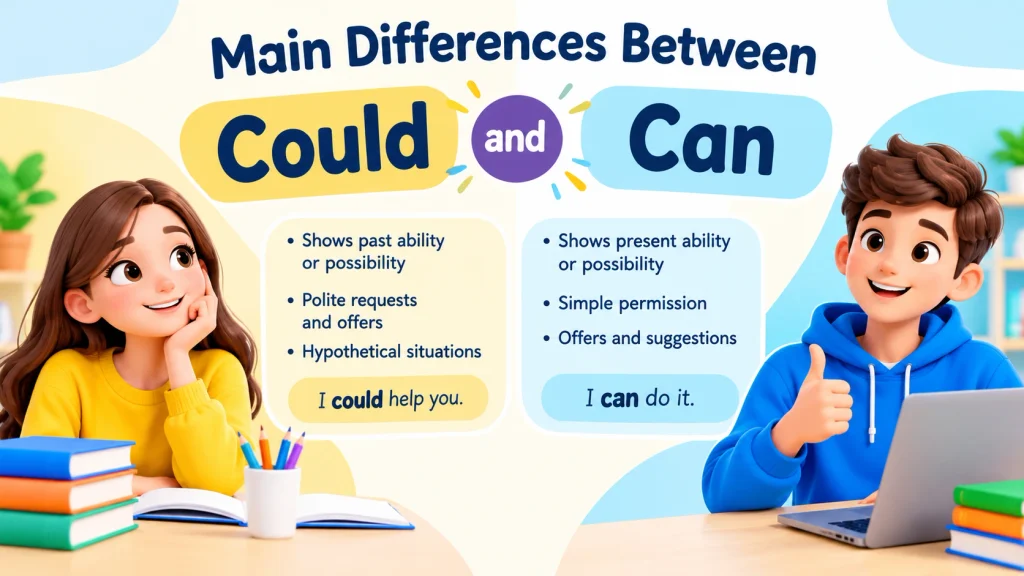
The primary difference between “could” and “can” is how they communicate ability, possibility, permission, and politeness.
| Feature | Can | Could |
| Present ability | I can swim. | Not usually used for direct present ability |
| Past general ability | Not usually used alone | I could swim at age five. |
| Present possibility | It can happen. | It could happen. |
| Future possibility | It can happen tomorrow. | It could happen tomorrow. |
| Permission | Can I leave? | Could I leave? |
| Requests | Can you help me? | Could you help me? |
| Suggestions | We can try again. | We could try again. |
| Hypothetical situations | Less common in conditional patterns | I could help if I had time. |
1. Present Ability vs. Past Ability
“Can” usually describes an ability someone has now, while “could” often describes an ability someone had in the past.
- Can: Emma can play the guitar.
- Could: Emma could play the guitar when she was a child.
The first sentence describes Emma’s current ability. The second describes a past ability and does not necessarily mean she can still play today.
2. Direct Requests vs. Polite Requests
Both words can introduce requests, but “could” often sounds more polite or less direct.
- Can: Can you open the window?
- Could: Could you open the window, please?
Both are correct. The second version may sound more considerate, although tone and context also influence politeness.
3. General Possibility vs. Uncertain Possibility
“Can” often describes general possibilities, while “could” frequently emphasizes a potential outcome or an uncertain situation.
- Can: Too much sunlight can damage your skin.
- Could: The weather could improve this afternoon.
The first sentence describes a general fact. The second describes something that may happen.
4. Permission in Different Situations
Both “can” and “could” can be used to ask permission.
- Can: Can I use your laptop?
- Could: Could I use your laptop?
The first is natural in casual conversation. The second often sounds more tentative or polite.
5. Real Situations vs. Hypothetical Situations
“Can” often describes practical ability or a real opportunity. “Could” is common when discussing imagined circumstances or situations that depend on a condition.
- Can: I can help you after work.
- Could: I could help you if I finished work early.
The second sentence makes the help conditional on another event.
Can vs. Could in Different Situations
The best choice also depends on the kind of communication you want to achieve.
Can or Could for Ability
Use “can” for current skills and “could” for general abilities in the past.
- I can cook Italian food.
- I could cook simple meals when I was ten.
For a specific achievement in the past, “was able to” may be more natural.
Can or Could for Possibility
Both words can describe possible events, but the emphasis can differ.
- Accidents can happen anywhere.
- We could miss the train if we leave late.
The first describes a general possibility; the second highlights a potential outcome in a particular situation.
Can or Could for Permission
Use “can” for straightforward, everyday permission and “could” for a more polite request.
- Can I take a break?
- Could I take a short break, please?
In formal settings, “may I” is another traditional option for asking permission.
Can or Could for Suggestions
Both can offer ideas, but “could” often presents a suggestion as one option among several.
- We can order pizza tonight.
- We could order pizza or cook at home.
The second example presents alternatives rather than emphasizing one practical plan.
Can or Could for Future Events
Neither word is exclusively a future-tense form. Both can refer to future situations.
- I can meet you tomorrow. — I am available.
- I could meet you tomorrow. — Meeting is a possibility, perhaps depending on other circumstances.
The surrounding conversation helps establish the intended meaning.
Grammar Guide
“Can” and “could” are modal auxiliary verbs, not nouns. They help express the meaning of the main verb in a sentence.
Both follow similar grammatical patterns, but their meanings differ according to tense, possibility, politeness, and context.
How Each Term Is Used in Sentences
1. Affirmative sentences
Pattern: Subject + can/could + base verb.
- She can dance.
- She could dance when she was younger.
- They can finish the assignment.
- They could finish the assignment if they worked together.
2. Negative sentences
Pattern: Subject + cannot/can’t or could not/couldn’t + base verb.
- I cannot attend the meeting.
- He can’t drive yet.
- We couldn’t find the address.
- She could not answer the question at the time.
3. Questions
Pattern: Can/Could + subject + base verb?
- Can you swim?
- Could you help me?
- Can they join us?
- Could she arrive earlier?
4. Conditional sentences
“Could” frequently appears in conditional sentences to describe an ability or opportunity that depends on a condition.
- If I had a car, I could drive to work.
- If we left earlier, we could catch the train.
- If she studied more, she could improve her grades.
Common Mistakes Learners Make
Mistake 1: Adding “to” after can or could
Incorrect: She can to speak French.
Correct: She can speak French.
Incorrect: He could to help us.
Correct: He could help us.
Remember that a modal verb is followed directly by the base form of the main verb.
Mistake 2: Adding -s to the main verb
Incorrect: He can speaks English.
Correct: He can speak English.
Incorrect: She could goes there.
Correct: She could go there.
The main verb does not take an -s ending after “can” or “could.”
Mistake 3: Using do or does in questions
Incorrect: Do you can swim?
Correct: Can you swim?
Incorrect: Does she could help?
Correct: Could she help?
Place the modal verb before the subject to form a question.
Mistake 4: Confusing past ability with a single past achievement
Less natural in many contexts: Yesterday, I could finish the difficult test.
More natural: Yesterday, I was able to finish the difficult test.
Use “could” for general past ability. For a specific successful action, “was able to” or “managed to” is often the better choice.
Mistake 5: Assuming could always means past time
Incorrect assumption: “Could” always describes something that happened in the past.
Actually, “could” can describe present possibilities, future possibilities, polite requests, and hypothetical situations.
Example: We could go shopping tomorrow.
Simple Rules to Remember
- Use can for present ability: “I can drive.”
- Use could for general past ability: “I could drive when I was seventeen.”
- Use can for direct requests: “Can you help?”
- Use could for often-more-polite requests: “Could you help?”
- Use can for general possibilities: “Exercise can improve fitness.”
- Use could for uncertain possibilities: “It could snow tonight.”
- Follow both modal verbs with the base form of the main verb.
- Do not use “do” or “does” to form questions with “can” or “could.”
Quick Tips for Writing and Speaking
- Ask yourself whether you mean present ability or past ability.
- Consider your tone before choosing between “can” and “could.”
- Use “could” when offering a tentative suggestion or describing an uncertain outcome.
- Avoid treating “could” as a simple past form in every sentence.
- Read the entire sentence to check whether the intended meaning is clear.
- Practice with pairs of sentences to understand the difference.
- Remember that “could” is not automatically more formal in every situation; context matters.
When to Use Each One
Choosing between “can” and “could” becomes easier when you identify the meaning you want to communicate.
Use Can When Describing Present Ability
Use “can” to explain what someone is capable of doing now.
Examples:
- I can solve this equation.
- My brother can repair computers.
- She can speak two languages.
Use Can for Direct Requests and Everyday Permission
“Can” is natural in informal conversations with friends, family, and colleagues.
Examples:
- Can you pass me the salt?
- Can I borrow your notebook?
- You can use my desk.
Use Could When Describing Past General Ability
Use “could” to describe something someone was generally capable of doing in the past.
Examples:
- I could run five kilometers when I was younger.
- He could read before he started school.
- They could communicate without a translator.
Use Could for Polite Requests
When you want to sound courteous or less direct, “could” is often a good choice.
Examples:
- Could you review my application?
- Could you please wait a moment?
- Could I speak with the manager?
Use Could for Uncertain Possibilities and Suggestions
Use “could” when something is possible but not guaranteed or when suggesting an option.
Examples:
- The package could arrive tomorrow.
- We could try another approach.
- This change could improve performance.
When NOT to Use Each One

Although “can” and “could” are versatile, they are not interchangeable in every sentence.
When Not to Use Can
1. When describing a past ability without a past-time construction
Incorrect: When I was six, I can swim.
Correct: When I was six, I could swim.
2. When making a hypothetical statement that requires could
Less appropriate: If I had more money, I can buy a new car.
Correct: If I had more money, I could buy a new car.
3. When forming a question with an extra auxiliary verb
Incorrect: Do you can help me?
Correct: Can you help me?
4. When a more tentative request is appropriate
“Can you explain this?” is grammatically correct, but “Could you explain this?” may be more suitable in a formal or sensitive interaction.
5. When describing a possibility that needs a conditional meaning
Incorrect for the intended hypothetical meaning: If we left earlier, we can catch the train.
Better: If we left earlier, we could catch the train.
When Not to Use Could
1. When you need to describe a current ability directly
Less direct: I could speak English fluently. (If you mean you can do so now.)
Better: I can speak English fluently.
2. When using the wrong verb form
Incorrect: She could speaks clearly.
Correct: She could speak clearly.
3. When referring to a specific past success without the intended meaning of general ability
Less natural: I could unlock the door yesterday after trying for an hour.
Better: I managed to unlock the door yesterday after trying for an hour.
4. When using could to express certainty
Less suitable: The sun could rise in the east tomorrow. (If stating a fact.)
Better: The sun rises in the east.
5. When making a direct statement of present ability
If you want to state a skill confidently, “can” is generally clearer than “could.”
Which One to Use: Decision Guide
Use the following guide to select the appropriate word based on your intended meaning.
Choose the Correct Word
What do you want to express?
Present ability or a current opportunity
General ability in the past
A polite request
A general possibility or fact
An uncertain possibility or suggestion
A hypothetical or conditional situation
Choose CAN
Example: I can finish this task today.
Remember that these are helpful guidelines, not absolute rules. Both words can express several meanings, and the context determines which one fits best.
Real-World Practical Examples
The following examples show how “can” and “could” work in different situations, from education and technology to everyday conversation.
Can Examples
- Education: Students can improve their writing by practicing every day.
- Daily life: I can prepare dinner before you arrive.
- Science: Water can exist as a solid, liquid, or gas.
- Business: Our team can complete the report by Friday.
- Technology: This application can store thousands of files.
- Conversation: Can you tell me where the library is?
- Health and fitness: Regular exercise can support overall well-being.
- Travel: We can take the train instead of driving.
- Writing: A strong opening can capture the reader’s attention.
- Problem-solving: We can find another solution if this plan fails.
These examples use “can” to express ability, practical opportunities, general possibilities, and requests.
Could Examples
- Education: I could understand difficult texts more easily when I practiced regularly.
- Daily life: We could make pasta for dinner tonight.
- Science: Small changes in temperature could affect the experiment’s results.
- Business: Could you send the updated proposal this afternoon?
- Technology: A software update could fix the problem.
- Conversation: Could I ask you something important?
- Health and fitness: Walking more often could help improve your stamina.
- Travel: We could visit the historical museum during our trip.
- Writing: Adding a personal story could make the article more engaging.
- Problem-solving: If we reorganized the schedule, we could save time.
These examples demonstrate past ability, polite requests, uncertain outcomes, suggestions, and conditional possibilities.
Self-Assessment: Fill in the Blanks
Test your understanding of “could” and “can” by completing the following 20 sentences. Choose the word that best fits the intended meaning.
- I ______ speak English fluently now.
- When she was four, she ______ count to one hundred.
- ______ you please explain this question to me?
- Too much noise ______ make it difficult to concentrate.
- We ______ visit the beach tomorrow if the weather is good.
- ______ I borrow your pen for a moment?
- If I had more free time, I ______ learn to play the piano.
- My grandfather ______ walk long distances when he was younger.
- This machine ______ print documents in color.
- ______ you help me carry these boxes, please?
- Our team ______ finish the project today because everyone is available.
- The missing document ______ be in the office.
- Before her injury, she ______ run very fast.
- ______ I speak to the department manager, please?
- Regular practice ______ improve your pronunciation.
- If we left earlier, we ______ avoid the traffic.
- He ______ solve complex problems without assistance now.
- We ______ try a different method if the first one fails.
- ______ you pass me the water, please?
- As a child, I ______ spend hours reading books.
Answers: Could or Can
- Can — It describes a present ability.
- Could — It describes a past ability.
- Could — It makes the request more polite.
- Can — It describes a general possibility.
- Could — It expresses a possible plan.
- Can — It asks for permission in a casual situation.
- Could — It describes a hypothetical ability or opportunity.
- Could — It describes a general ability in the past.
- Can — It describes the machine’s current capability.
- Could — It makes a polite request.
- Can — It expresses a current ability or opportunity.
- Could — It suggests an uncertain possibility.
- Could — It describes a general past ability.
- Could — It makes a polite request.
- Can — It describes a general possibility.
- Could — It expresses a possible result of a hypothetical condition.
- Can — It describes a present ability.
- Could — It suggests an alternative approach.
- Could — It makes a polite request.
- Could — It describes a repeated past activity or ability.
Note: Some sentences can naturally use either word with a different emphasis. These answers reflect the most likely intended meaning in each context.
Final Verdict
The difference between “could” and “can” comes down to meaning, context, and tone. Both are correct modal verbs, but each serves a slightly different purpose in English.
Use can when describing present ability, asking straightforward questions, giving everyday permission, or explaining general possibilities. For example, “I can finish this assignment today” communicates a current ability or opportunity.
Use could when discussing general past ability, making polite requests, suggesting alternatives, or describing uncertain and hypothetical situations. For example, “Could you help me with this assignment?” sounds more courteous, while “I could finish it if I had more time” expresses a conditional possibility.
The most important grammar rule is that both words take the base form of the main verb. Say “She can write” or “She could write,” not “She can writes” or “She could to write.”
Ultimately, neither word is universally better than the other. Choose the one that accurately expresses your intended meaning, and your writing and conversations will sound clearer, more natural, and more confident.
Conclusion
Understanding the difference between could and can can make your English writing and everyday conversations clearer, more natural, and more confident. Although both words are modal verbs, they communicate different meanings depending on the situation. Use “can” to describe present abilities, everyday permission, and general possibilities. For example, “I can solve this problem” expresses a current ability. In contrast, use “could” to describe general past abilities, make polite requests, suggest alternatives, or discuss hypothetical situations. For instance, “Could you help me?” sounds more polite, while “I could help if I had more time” describes a conditional possibility.
Remember that both words are followed by the base form of the main verb, without “to” or an additional verb ending. With regular practice, you will learn to choose the correct word naturally. Whether you are writing an article, preparing an assignment, or speaking with others, knowing when to use could or can will help you communicate your ideas effectively.
FAQs
What is the main difference between could and can?
“Can” generally expresses present ability, permission, or general possibility, while “could” often expresses past ability, uncertain possibility, hypothetical situations, or polite requests. For example, “I can swim” describes a current ability, whereas “I could swim when I was younger” describes a past ability. The correct choice depends on your intended meaning and context.
Is could the past tense of can?
Yes, “could” is commonly used as the past form of “can” when describing general abilities in the past. For example, “I can run fast” describes a present ability, while “I could run fast as a child” describes a past ability. However, could also expresses present or future possibilities, polite requests, and hypothetical situations.
Is could more polite than can?
Yes, “could” often sounds more polite or less direct than “can” when making requests. For example, “Can you help me?” is a normal request, while “Could you help me?” sounds more courteous. Both expressions are grammatically correct, and the best choice depends on your relationship with the listener and the situation.
Can I use could for present situations?
Yes, “could” can describe present possibilities, suggestions, and hypothetical situations. For example, “This could be the answer” expresses a possibility in the present. Similarly, “We could eat at home” suggests an option. Although could sometimes refers to past ability, it does not always indicate that something happened in the past.
Should I use can or could when asking permission?
Both are correct when asking permission. “Can I leave early?” is common in everyday conversation, while “Could I leave early?” often sounds more polite or tentative. In formal settings, you may also use “May I leave early?” Choose the expression that suits your audience, relationship, and level of formality.
Can, could, and can be used for future possibilities?
Yes, both words can refer to future situations. “I can meet you tomorrow” usually indicates availability or a practical opportunity. “I could meet you tomorrow” presents the meeting as a possibility that may depend on other circumstances. Neither word is exclusively a future-tense form, so context determines the intended meaning.
What verb form follows can and could?
Both “can” and “could” must be followed by the base form of the main verb. For example, say “She can write” and “He could drive,” not “She can writes” or “He could to drive.” This rule applies to affirmative sentences, negative sentences, and questions, making it one of the most important modal verb rules.
Is it correct to say could of instead of could have?
In standard English, “could have” is correct, while “could of” is incorrect in writing. The confusion occurs because the contraction “could’ve” sounds similar to “could of” in everyday speech. For example, write “I could have helped you,” or “I could’ve helped you.” Use the full form when you want especially clear, formal writing.
Can could express possibility instead of certainty?
Yes, “could” frequently expresses possibility rather than certainty. For example, “It could rain tonight” means rain is possible but not guaranteed. Similarly, “This change could improve results” suggests a potential outcome. When using could, consider whether you want to communicate uncertainty, propose an option, or describe a situation that depends on specific conditions.
How can I remember when to use could or can?
Remember that “can” usually describes present ability or general possibility, while “could” often describes past ability, polite requests, uncertain outcomes, and hypothetical situations. Practice comparing sentences such as “I can help today” and “I could help if I had time.” Learning through examples will help you recognize the correct choice more naturally.

