
“Would” and “will” are common English modal verbs that help us talk about the future, possibilities, intentions, and hypothetical situations. Although they may seem similar, they serve different purposes in sentences. Understanding the difference between would and will can improve your grammar, writing, and everyday conversations. This guide explains their meanings, rules, differences, and practical examples.
Comparison Overview
Would and will are modal auxiliary verbs that express different ideas depending on the context. Both can refer to actions, decisions, and expectations, but they communicate different levels of certainty, intention, or possibility.
Will generally describes future actions, predictions, promises, and decisions. For example, “I will call you tomorrow” expresses a definite intention or commitment.
Would often describes hypothetical situations, polite requests, imagined outcomes, and actions viewed from a past perspective. For example, “I would call you if I had your number” describes a conditional situation.
Neither word is universally better than the other. The correct choice depends on what you want to express.
Definition of Would
Would is a modal auxiliary verb used to express hypothetical situations, polite requests, preferences, repeated past actions, and future actions viewed from a past perspective.
It often helps speakers communicate ideas that depend on a condition or are not presented as definite facts.
Meaning and Purpose of Would
Here are the main uses of would:
- Hypothetical situations: Describe imagined or unreal circumstances.
- Conditional sentences: Explain what might happen if a condition were met.
- Polite requests: Make requests sound less direct.
- Past habits: Describe repeated actions in the past.
- Future in the past: Explain what someone expected or planned to happen later.
- Preferences: Express wishes or choices politely.
Examples of Would
- I would travel more if I had enough money.
- Would you please open the window?
- When we were children, we would play outside every evening.
- She said she would visit us the following week.
- I would rather stay home tonight.
In each example, would serves a purpose that differs from simply stating a future intention.
Definition of Will
Will is a modal auxiliary verb commonly used to express future actions, predictions, promises, offers, and decisions.
It is especially useful when speakers want to communicate what they expect to happen or what they intend to do.
Meaning and Purpose of Will
Here are the main uses of will:
- Future actions: Describe something expected or planned to happen.
- Predictions: State what someone believes will happen.
- Promises: Communicate a commitment.
- Spontaneous decisions: Express a decision made while speaking.
- Offers: Volunteer to help someone.
- Willingness: Show readiness or determination to do something.
Examples of Will
- I will finish my homework tonight.
- It will rain tomorrow, according to the forecast.
- I will always support you.
- The phone is ringing. I will answer it.
- We will help you move the furniture.
These examples show how will communicates future expectations, commitments, and willingness.
Main Differences Between Would and Will
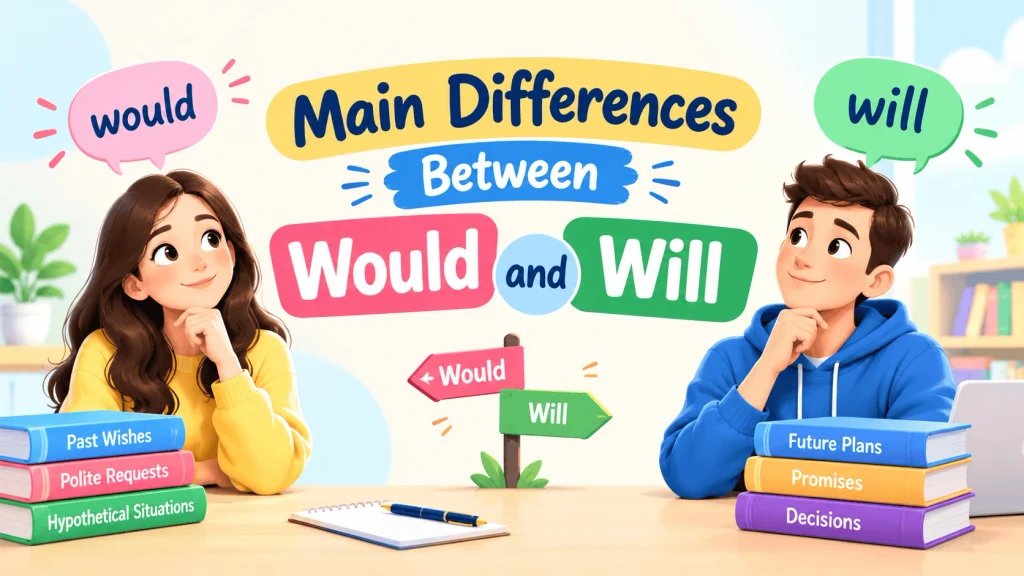
The primary difference between would and will is how they express certainty, conditions, and intention. Will generally presents a future action or prediction directly, while would often introduces a hypothetical situation, a polite expression, or a future action viewed from the past.
Comparison Table
| Feature | Would | Will |
| Main purpose | Hypothetical situations and other context-dependent meanings | Future actions and predictions |
| Certainty | Often conditional or imagined | Often expresses an expected or intended outcome |
| Conditional sentences | Common in the result clause of second and third conditional patterns | Common in the main clause of first conditional patterns |
| Politeness | Often makes requests more polite | Can express direct requests or offers |
| Past perspective | Can describe future actions viewed from the past | Usually expresses a future action from the present perspective |
| Past habits | Can describe repeated past actions | Does not normally describe past habits |
| Promises | Can express conditional or imagined commitments | Commonly expresses direct promises |
| Example | I would help if I could. | I will help you tomorrow. |
Difference in Meaning
Compare these sentences:
- I will buy a car. This expresses an intention or expectation about the future.
- I would buy a car if I had enough money. This describes a hypothetical decision that depends on a condition.
The first sentence presents the action as a future intention. The second explains what the speaker would do under different circumstances.
Difference in Certainty
Will often communicates a stronger expectation or intention than would, although neither word guarantees that an event will happen.
For example:
- “She will attend the meeting” expresses an expectation or intention.
- “She would attend the meeting if she were available” describes a conditional situation.
The second sentence makes the condition important to the meaning.
Difference in Politeness
Would often makes questions and requests sound more courteous.
- “Will you help me?” asks whether someone is willing to help.
- “Would you help me?” can sound more tentative or polite.
Both sentences are grammatically correct. The most suitable option depends on the relationship between the speakers and the situation.
Grammar Guide
Would and will are modal auxiliary verbs. They work with a main verb to express ideas such as intention, possibility, prediction, or willingness.
Neither word changes according to the subject. For example, we say “I will go,” “she will go,” and “they will go.” The same rule applies to would.
How Each Term Is Used in Sentences
1. Basic sentence structure
Use this pattern:
Subject + would/will + base form of the verb.
Examples:
- I will learn English.
- She will arrive soon.
- I would learn French if I had more time.
- He would accept the offer under different circumstances.
2. Negative sentences
Add not after would or will.
- I will not attend the event.
- She would not agree with that decision.
- They won’t arrive before noon.
- He wouldn’t make that mistake intentionally.
The contractions are won’t for will not and wouldn’t for would not.
3. Questions
Place would or will before the subject.
- Will you join us?
- Would you like some coffee?
- Will she finish the report?
- Would they accept the invitation?
4. Conditional sentences
Will commonly appears in the main clause of a first conditional sentence.
Example: If you study hard, you will improve your English.
Would commonly appears in the result clause of a second conditional sentence.
Example: If I had more time, I would learn another language.
In standard conditional constructions, the if-clause normally uses the appropriate tense rather than will or would directly.
Common Mistakes Learners Make
Mistake 1: Using would for every future action
Incorrect: I would visit you tomorrow.
This sentence is possible in certain contexts, such as a conditional or reported statement, but it is not the clearest choice for a simple future intention.
Better: I will visit you tomorrow.
Mistake 2: Using will in an ordinary second conditional
Incorrect: If I had more money, I will buy a bigger house.
Correct: If I had more money, I would buy a bigger house.
The second conditional describes an imagined or unlikely situation.
Mistake 3: Adding “to” after would or will
Incorrect: She will to attend the meeting.
Correct: She will attend the meeting.
Modal verbs take the base form of the main verb without to.
Mistake 4: Adding -s to the main verb
Incorrect: He will goes to school.
Correct: He will go to school.
The main verb stays in its base form after both would and will.
Mistake 5: Confusing polite requests with future statements
“Would you open the door?” is a request, while “You will open the door” can sound like a prediction or an instruction.
Choose the expression that matches your intended meaning.
Simple Rules to Remember
- Use will for future intentions, predictions, promises, and offers.
- Use would for hypothetical situations and many polite requests.
- Use would to describe future actions viewed from a past perspective.
- After both modal verbs, use the base form of the main verb.
- In ordinary second conditional sentences, use would in the result clause.
- Use the negative forms won’t and wouldn’t when needed.
- Choose based on meaning and context rather than assuming one word is always more correct.
Quick Tips for Writing and Speaking
- Ask yourself whether you are describing an intended future action or an imagined situation.
- Use will when making a straightforward promise, such as “I will send the file today.”
- Use would for courteous requests, such as “Would you mind waiting?”
- Read the whole conditional sentence before selecting a modal verb.
- Avoid using would merely to make every statement sound more formal.
- Check whether the sentence refers to the future from a past viewpoint, as in “He knew he would succeed.”
When to Use Each One
Both words are useful in everyday English, but their functions differ.
When to Use Would
Use would when you want to:
Describe hypothetical situations
- I would move abroad if I found a good job.
- She would feel happier with more support.
Make polite requests
- Would you please explain this rule?
- Would you mind closing the door?
Express preferences
- I would rather read than watch television.
- I would prefer tea to coffee.
Describe repeated past actions.
- Every summer, we would visit our grandparents.
- After dinner, my father would tell us stories.
Report a future intention from the past
- He promised that he would call.
- She believed the team would win.
When to Use Will
Use will when you want to:
Talk about plans or intentions
- I will start my new course next Monday.
- We will meet you at the station.
Make predictions
- The new technology will change how people work.
- I think the weather will improve.
Make promises
- I will keep your information confidential.
- We will do our best to help.
Offer assistance
- I will carry those bags for you.
- I will explain the answer.
Make spontaneous decisions
- Someone is at the door. I will see who it is.
- You look tired. I will make some coffee.
When NOT to Use Each One
Understanding when not to use would or will helps prevent common grammar mistakes.
When Not to Use Would
Do not normally use would for a straightforward future intention when you mean that you plan or expect to do something.
Less suitable without additional context: I would call you tonight.
Clearer for a direct intention: I will call you tonight.
However, the first sentence can be correct if the context supplies a condition or another relevant meaning.
Do not use would in the ordinary if-clause of a standard second conditional sentence.
Incorrect: If I would have more time, I would exercise.
Correct: If I had more time, I would exercise.
Remember that would can still appear in if-clauses in special constructions, such as when it expresses willingness, so context matters.
When Not to Use Will
Do not normally use will in the result clause of a standard second conditional sentence when describing an unreal or hypothetical present situation.
Incorrect: If I were taller, I will play basketball professionally.
Correct: If I were taller, I would play basketball professionally.
Do not add to or change the main verb after will.
Incorrect: She will to finish the assignment.
Correct: She will finish the assignment.
Also, do not assume that will is the best choice for every future reference. English can use the present simple, present continuous, or be going to for particular future meanings.
Would or Will in Conditional Sentences
Conditional sentences are one of the most important areas where learners must distinguish would from will.
First Conditional: Will
The first conditional describes a real or possible future situation.
Structure: If + present simple, will + base verb.
Examples:
- If it rains, we will stay inside.
- If you practice daily, you will improve.
- If she arrives early, we will start the meeting.
These sentences describe outcomes that are possible in the future.
Second Conditional: Would
The second conditional describes an imaginary, unlikely, or hypothetical situation.
Structure: If + past simple, would + base verb.
Examples:
- If I won the lottery, I would travel the world.
- If he studied harder, he would get better grades.
- If we lived near the beach, we would swim every day.
The past form in the if-clause does not necessarily refer to past time. It signals a hypothetical distance from reality.
Third Conditional: Would Have
The third conditional describes an imagined past outcome that did not happen.
Structure: If + past perfect, would have + past participle.
Examples:
- If I had left earlier, I would have caught the train.
- If she had studied, she would have passed the exam.
- If they had booked in advance, they would have found better seats.
Will is not normally used in the result clause of this standard conditional pattern.
Would or Will in Reported Speech
Would often functions as the past form of will in reported speech, especially when the reporting verb is in the past.
Direct speech: “I will help you.”
Reported speech: She said she would help me.
More examples:
- Direct: “We will finish the project.”
- Reported: They said they would finish the project.
- Direct: “I will call tomorrow.”
- Reported: He promised he would call the following day.
This change is common in reported speech, but it is not compulsory in every context. Speakers sometimes retain will when the statement remains current, or the reporting context allows it.
Would or Will in Polite Communication
Both words can appear in questions, but would often sounds more tentative or courteous.
| Situation | Example | Purpose |
| Asking for help | Would you help me with this form? | Polite request |
| Asking about willingness | Will you help me move tomorrow? | Direct question |
| Offering help | I will carry your bag. | Offer |
| Making a courteous offer | Would you like me to carry your bag? | Polite offer |
| Asking about preferences | Would you prefer tea or coffee? | Polite choice |
These are tendencies rather than absolute rules. Tone, context, and the relationship between speakers can affect how each sentence sounds.
Which One to Use (Decision Guide)
Use the following guide to choose the correct word quickly.
| What do you want to express? | Best choice | Example |
| A future intention | Will | I will call you later. |
| A future prediction | Will | The team will win. |
| A promise | Will | I will keep my word. |
| A hypothetical action | Would | I would go if I could. |
| A polite request | Would | Would you open the window? |
| A preference | Would | I would rather stay home. |
| A future action viewed from the past | Would | She knew he would return. |
| A repeated past habit | Would | We would walk there every morning. |
| An unreal past result | Would have | I would have helped if I had known. |
A simple decision rule: If you mean a straightforward future action, consider will. If you mean an imagined situation, a polite request, a past habit, or a future event viewed from the past, consider would.
Always check the full sentence to confirm the intended meaning.
Real-World Practical Examples
The following examples show how would and will work in different situations, including education, business, daily life, science, and technology.
Would Examples
- Education: If I had more time, I would review my notes before the exam.
- Daily life: Would you please pass me the salt?
- Business: The manager said she would review the proposal.
- Science: Researchers would conduct more experiments if additional funding were available.
- Technology: I would upgrade my computer if the new model were more affordable.
- Writing: I would describe the character as thoughtful rather than careless.
- Travel: We would visit Japan if we could take a longer vacation.
- Conversation: Would you like to join us for dinner?
- Past habits: During summer vacations, we would ride our bicycles every evening.
- Hypothetical decisions: I would choose the simpler design if both options cost the same.
Will Examples
- Education: I will submit my assignment before the deadline.
- Daily life: I will wash the dishes after dinner.
- Business: Our team will present the results on Friday.
- Science: The laboratory will publish its findings after reviewing the data.
- Technology: The application will install the update automatically.
- Writing: I will revise the introduction to make it clearer.
- Travel: We will leave for the airport at six in the morning.
- Conversation: I will call you when I arrive.
- Customer service: We will respond to your request as soon as possible.
- Predictions: Electric vehicles will play an important role in future transportation.
Self-Assessment (Fill in the Blanks)
Complete each sentence with would, will, would have, or wouldn’t, as appropriate. Pay attention to the meaning and grammatical structure.
- I ______ call you tomorrow to discuss the project.
- If I had more free time, I ______ learn to play the piano.
- She promised she ______ send the documents the next day.
- ______ you please help me carry these boxes?
- If it rains tomorrow, we ______ cancel the outdoor event.
- If he studied regularly, he ______ understand the subject better.
- I ______ rather drink water than soda.
- The teacher believes the students ______ pass the examination.
- If I had known about the meeting, I ______ have attended it.
- The phone is ringing. I ______ answer it.
- When we were young, we ______ visit our cousins every summer.
- If she were more confident, she ______ speak in public more comfortably.
- Don’t worry. I ______ help you finish the task.
- He said he ______ return the book the following week.
- If they had left earlier, they ______ have reached the station on time.
- ______ you like some tea?
- If I were the manager, I ______ change the current policy.
- I ______ forget your kindness, and I promise to remember your support.
- If you practice every day, you ______ improve your pronunciation.
- If I had seen your message earlier, I ______ have replied sooner.
Answers
- will — The sentence expresses a future intention.
- would — The sentence describes a hypothetical situation.
- would — Would reports a future promise from a past perspective.
- Would — Would makes the request polite.
- will — The sentence uses the first conditional.
- would — The sentence uses the second conditional.
- would — Would appears in the expression “would rather.”
- will — Will expresses a prediction or expectation.
- would — The correct phrase is “would have attended,” describing an unreal past result.
- will — Will expresses a spontaneous decision.
- would — Would describes a repeated past habit.
- would — The sentence describes a hypothetical result.
- will — Will communicates a promise or offer of help.
- would — Would reports a future action from a past perspective.
- would — The correct phrase is “would have reached,” describing an unreal past result.
- Would — Would makes the offer polite.
- would — The sentence describes an imagined situation.
- will — Will expresses a promise. The complete sentence is “I will never forget your kindness.”
- will — The sentence uses the first conditional.
- would — The correct phrase is “would have replied,” describing an unreal past result.
Final Verdict
Both would and will are correct English modal verbs, but they serve different purposes. The key is understanding the meaning you want to communicate rather than choosing one word automatically.
Use will for straightforward future intentions, predictions, promises, offers, and decisions. For example, “I will finish the report tomorrow” communicates a clear intention.
Use would for hypothetical situations, polite requests, preferences, repeated past habits, and future actions viewed from a past perspective. For example, “I would finish the report if I had more time” describes a condition that has not been met.
Remember that would and will are followed by the base form of the main verb. In conditional sentences, will commonly appears in first conditional patterns, while would commonly appears in second conditional patterns. For unreal past situations, use the structure “would have” followed by a past participle.
With regular practice, you can confidently choose between would and will in conversations, academic writing, professional communication, and everyday English.
Add FAQs and a meta description. Shorten repetitive explanations and examples.
Conclusion
Understanding the difference between would and will can make your English clearer, more natural, and more confident. Although both words are modal verbs, they express different meanings depending on the situation. Use will when discussing future intentions, predictions, promises, offers, or decisions. For example, “I will help you tomorrow” communicates a direct intention to help.
On the other hand, use would when describing hypothetical situations, polite requests, preferences, repeated past habits, or future actions viewed from a past perspective. For instance, “I would help you if I had more time” expresses a conditional situation.
Remember that both words are followed by the base form of the main verb, such as go, write, or learn. Practicing their use in everyday conversations and writing will help you recognize the difference more easily. Whether you are learning English or improving your grammar, mastering would and will will help you express your thoughts accurately and communicate with greater confidence.
FAQs
Is would or will grammatically correct?
Both would and will are grammatically correct modal verbs. The appropriate choice depends on the meaning and context of your sentence. Use will for a straightforward future intention, such as “I will call you later.” Use would for a hypothetical situation, such as “I would call you if I had your number.” Neither word is universally correct in every situation.
Should I use would or will for the future?
Use will when expressing a direct future intention, prediction, or promise. For example, “I will finish my assignment tonight” communicates a future commitment. Would can also refer to future actions when reporting past expectations or describing hypothetical situations. For example, “She said she would finish the assignment.” The correct choice depends on your sentence’s meaning and grammatical structure.
Can I use would and will in the same sentence?
Yes, you can use would and will in the same sentence when each serves a different grammatical purpose. For example, “I will help you if I can” uses will to express a future intention. In another context, “I would help you if I could, and I will if circumstances change” uses both words to distinguish a hypothetical situation from a future possibility.
Is would more polite than will?
Would often sounds more polite or less direct than will, particularly when making requests or offers. For example, “Would you help me?” sounds more tentative than “Will you help me?” However, both can be polite depending on tone and context. Would is especially common in courteous expressions such as “Would you mind opening the window?” or “Would you like some tea?”
Do would and will follow the same grammar rules?
Yes, both are modal auxiliary verbs and follow the same basic sentence pattern: subject + modal verb + base form of the main verb. For example, say “She will work” and “She would work,” not “She will works” or “She would worked.” For negatives, add not after the modal, as in “will not” and “would not.”
Should I use would or will in conditional sentences?
The choice depends on the type of conditional sentence. Use will in the result clause of a first conditional sentence describing a possible future outcome: “If it rains, we will stay home.” Use would in the result clause of a second conditional sentence describing an imagined situation: “If I had more time, I would exercise.” These patterns help communicate different levels of possibility.
What is the difference between would and would have?
Would commonly describes hypothetical situations, polite requests, or imagined outcomes in the present or future. Would have, followed by a past participle, often describes an unreal past result. For example, “I would help if I could” expresses a hypothetical situation, while “I would have helped if I had known” describes something that did not happen because the condition was not met.
Can would describe past habits?
Yes, would can describe repeated actions or habits in the past. For example, “When I was a child, I would visit my grandparents every weekend.” This usage emphasizes repeated past behavior rather than a single completed event. However, would does not normally describe past states in the same way. For example, “I used to be shy” is more natural than “I would be shy.”
How can I remember when to use would or will?
Remember that will usually expresses a direct future intention, prediction, or promise, while would often expresses a hypothetical situation, polite request, or future action viewed from the past. Compare “I will buy a car” with “I would buy a car if I had enough money.” Practicing similar sentence pairs is an effective way to understand the difference and improve your English grammar.

