“Mother tongue” and “native language” are often used interchangeably, but they can describe slightly different aspects of a person’s language background. Both terms refer to languages learned naturally from an early age, yet their emphasis can differ depending on family, culture, upbringing, and personal experience. Understanding this distinction helps you choose the most accurate expression in everyday, academic, and professional writing.
Comparison Overview
Mother tongue and native language are closely related terms. In many everyday situations, they can refer to the same language—the language a person learned first or grew up speaking.
However, there is a subtle difference in emphasis:
- Mother tongue often emphasizes family, home, cultural background, or the language passed down through a community.
- Native language generally emphasizes a language acquired naturally from early childhood.
- A person may have more than one native language if they grew up learning multiple languages from childhood.
- Someone’s mother tongue and strongest language do not necessarily have to be the same.
- The terms can vary in meaning depending on cultural and linguistic context.
For example, someone may grow up in a multilingual household where one parent speaks Urdu, and another speaks Punjabi. Depending on upbringing and usage, both languages may be described as native languages, while the term “mother tongue” may be used differently by the individual or community.
Definition of Mother Tongue
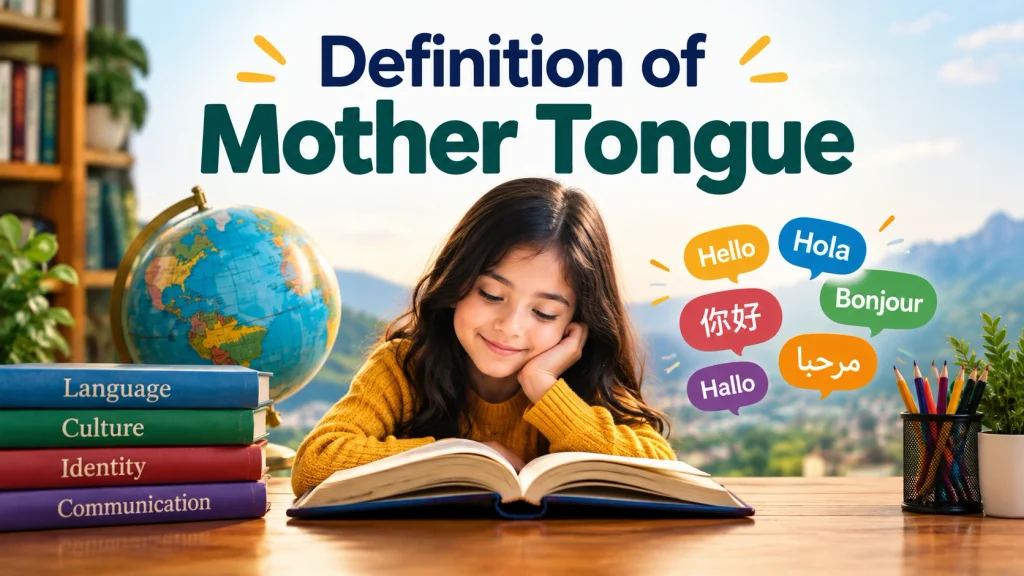
A mother tongue is generally the language a person first learns in childhood, particularly within the family or home environment.
The expression traditionally suggests a language transmitted from parents or the surrounding community. It is often associated with cultural identity, heritage, and early family communication.
For example:
My mother tongue is Punjabi, but I use English at work.
Here, “mother tongue” highlights the speaker’s linguistic and cultural background rather than simply identifying the language they currently use most frequently.
The term does not necessarily mean that a person’s mother literally taught them the language. It is a traditional expression referring to an early or inherited language.
Definition of Native Language
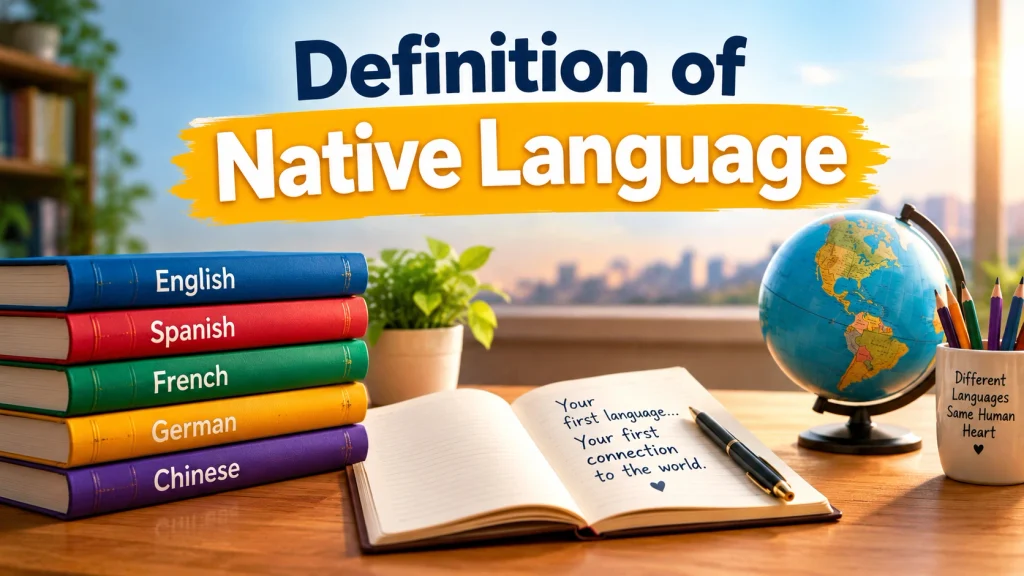
A native language is a language that a person acquires naturally from early childhood, usually through regular exposure and interaction rather than formal classroom study.
For example:
English is her native language.
This means she acquired English naturally while growing up.
“Native language” often focuses more on how and when the language was acquired than on family heritage alone.
A person can potentially have two or more native languages when they are exposed to and naturally acquire multiple languages during childhood.
Main Differences Between Mother Tongue and Native Language
Although the expressions overlap considerably, their emphasis can differ.
| Feature | Mother Tongue | Native Language |
| Basic meaning | Language associated with early family or cultural upbringing | Language naturally acquired during early childhood |
| Main emphasis | Family, heritage, culture, or community | Natural childhood acquisition |
| Number | May refer to one primary heritage language | Can describe multiple languages acquired natively |
| Common context | Culture, identity, education, demographics | Linguistics, language learning, everyday communication |
| Formality | Common but sometimes considered less precise | Often preferred when discussing language acquisition |
| Example | “Urdu is my mother tongue.” | “Urdu is my native language.” |
The difference is therefore usually one of emphasis rather than completely different meanings.
Mother Tongue vs Native Language in Linguistics
In linguistic discussions, these terms can become more complicated.
“Mother tongue” does not have one universally fixed technical definition. Different people and institutions may use it to mean:
- First language learned
- Family language
- Heritage language
- Community language
- Language associated with cultural identity
“Native language” can also have different interpretations, but it generally refers to a language acquired naturally from childhood.
For this reason, linguists may use more specific terms such as first language (L1), heritage language, or native language when precision is important.
First Language vs Mother Tongue
First language usually refers to the language acquired first.
Mother tongue may refer to the language connected to family or cultural heritage.
These can be identical, but they do not always have to be.
For example, a child might first acquire English after moving to an English-speaking country, while the family continues to identify another language as the child’s mother tongue.
Native Language vs First Language
“Native language” and “first language” frequently overlap.
However, first language focuses specifically on acquisition order, while native language commonly emphasizes natural childhood acquisition and native-level linguistic background.
Are Mother Tongue and Native Language Synonyms?
In everyday English, they can often function as synonyms.
For example, these sentences may communicate essentially the same idea:
Spanish is my mother tongue.
Spanish is my native language.
However, they can carry different connotations. “Mother tongue” may sound more connected to family, heritage, and culture, while “native language” can sound more neutral or linguistic.
Therefore, the best choice depends on what you want to emphasize.
Grammar Guide
Both mother tongue and native language are noun phrases.
- Mother = noun functioning as a modifier
- Tongue = noun
- Native = adjective
- Language = noun
The phrase mother tongue is therefore a noun phrase meaning a person’s traditional or early language.
The phrase native language is also a noun phrase meaning a language naturally acquired from early childhood.
How Each Term Is Used in Sentences
Use mother tongue when discussing family background, cultural heritage, or the language associated with someone’s upbringing.
Pattern:
Subject + possessive + mother tongue + is + language.
Example:
Urdu is my mother tongue.
Use native language when emphasizing natural childhood language acquisition.
Pattern:
Subject + possessive + native language + is + language.
Example:
English is her native language.
Both can also be used with verbs such as speak, learn, use, and understand.
He speaks his mother tongue at home.
She learned her native language as a child.
Common Mistakes Learners Make
Mistake 1: Assuming “mother tongue” always means the language spoken by one’s mother.
The expression usually refers to an early or heritage language, not necessarily the literal language spoken by someone’s mother.
Mistake 2: Assuming everyone has only one native language
Some people grow up naturally acquiring two or more languages.
Mistake 3: Treating native language as the language currently spoken most often
A person’s strongest or most frequently used language can change over time.
Mistake 4: Assuming mother tongue must be the first language learned
In some contexts, “mother tongue” is used to describe heritage or family language rather than strict acquisition order.
Mistake 5: Confusing native language with national language
A country’s official or dominant language is not automatically every citizen’s native language.
Simple Rules to Remember
Remember these simple distinctions:
- Mother tongue → think family, heritage, and cultural background.
- Native language → think natural childhood acquisition.
- Both terms can refer to the same language.
- A person can have multiple native languages.
- Neither term necessarily means the language someone currently speaks most often.
- In technical writing, use more specific terminology when precision is important.
Quick Tips for Writing and Speaking
Use mother tongue when talking about:
- Family language
- Cultural heritage
- Identity
- Traditional community language
Use native language when talking about:
- Childhood acquisition
- Linguistic background
- Language-learning experience
- Native-level language ability
If you are writing for an academic or linguistic audience, consider whether first language, heritage language, or L1 would communicate your intended meaning more precisely.
When to Use Each One
When to Use “Mother Tongue”
Use mother tongue when the context involves family, heritage, culture, or identity.
Examples include:
The students were encouraged to write in their mother tongue.
She speaks her mother tongue with her grandparents.
The festival celebrates local traditions and mother tongues.
When to Use “Native Language”
Use native language when discussing a language naturally acquired during childhood.
Examples include:
English is his native language.
She is a native speaker of Spanish.
A more natural version of the second sentence would usually be:
Spanish is her native language.
When NOT to Use Each One
When “Mother Tongue” May Be Less Precise
Avoid relying on “mother tongue” when you specifically need to describe the first language acquired and the person’s family or heritage language differs.
In such cases, “first language” may be clearer.
When “Native Language” May Be Less Precise
Avoid using “native language” if you actually mean a person’s heritage language, especially when that language was not actively acquired or used during childhood.
For example, a person may have grandparents who speak a particular language without the person actually learning it as a child.
Which One to Use (Decision Guide)
Use this quick guide:
| If you mean… | Use… |
| Language connected to family heritage | Mother tongue |
| Language naturally acquired during childhood | Native language |
| The first language acquired | First language |
| A family/community language that may not be fully spoken | Heritage language |
| A person’s strongest current language | Dominant language |
| A language learned after childhood | Second language / additional language |
If you are simply describing the language someone grew up speaking, either “mother tongue” or “native language” may work, depending on the context.
Real-World Practical Examples
Mother Tongue Examples
Education:
Students were allowed to discuss difficult concepts in their mother tongue before presenting them in English.
Daily Life:
I usually speak my mother tongue with my grandparents.
Culture:
The community works to preserve its mother tongue for future generations.
Writing:
The author occasionally includes expressions from his mother tongue in the novel.
Conversation:
What is your mother tongue?
Family:
The children learned their mother tongue from their family while growing up.
Business:
The company provides customer support in several local mother tongues.
Technology:
The application includes language settings for several users’ mother tongues.
Native Language Examples
Education:
She learned to read and write in her native language before studying English.
Daily Life:
He still speaks his native language with his family.
Science:
Participants were asked to complete the language assessment in their native language.
Business:
The company hired translators who could communicate with clients in their native language.
Writing:
The researcher published a version of the article in her native language.
Technology:
The software supports voice commands in several native languages.
Conversation:
Is English your native language?
Travel:
The traveler felt more comfortable speaking her native language with people from her home region.
Self-Assessment (Fill in the Blanks)
Complete each sentence with mother tongue, native language, first language, or another appropriate term where needed.
- I speak my ________ with my grandparents because it is part of our family heritage.
- English is her ________, as she acquired it naturally during childhood.
- The researcher wanted to know which ________ each participant learned first.
- The community is working to preserve its traditional ________.
- He grew up speaking Spanish naturally, so Spanish is his ________.
- The student uses her ________ when communicating with family members.
- A person can have more than one ________ if multiple languages were naturally acquired during childhood.
- The teacher encouraged students to explain difficult ideas in their ________.
- His family moved abroad when he was young, and English eventually became his strongest language, although another language remained his ________.
- When discussing childhood acquisition specifically, ________ may be more precise than “mother tongue.”
- Maria learned French naturally from both parents while growing up, so French can be described as her ________.
- The cultural organization offers classes designed to preserve the community’s ________.
- If I am talking specifically about the language I learned first, I can use the term ________.
- “Mother tongue” often emphasizes family and ________ background.
- “Native language” generally emphasizes natural ________ during childhood.
- A country’s official language is not necessarily every citizen’s ________.
- Someone may use a language every day without it being their ________.
- A person who learns a language for the first time as an adult would not normally call it their ________.
- The phrase “mother tongue” is a ________ phrase used to refer to an early or heritage language.
- When discussing family heritage rather than strict acquisition order, ________ may be appropriate.
Answers
- mother tongue — The context emphasizes family heritage.
- native language — The sentence focuses on natural childhood acquisition.
- first language — The sentence specifically asks which language was learned first.
- mother tongue — The context emphasizes preservation of a traditional community language.
- native language — The language was acquired naturally during childhood.
- mother tongue — The context emphasizes family communication.
- native language — Multiple languages can be naturally acquired during childhood.
- mother tongue — The context can refer to students’ familiar family or community language.
- mother tongue — The sentence contrasts a heritage language with the strongest current language.
- first language — It specifically describes acquisition order.
- native language — French was naturally acquired during childhood.
- mother tongue — The emphasis is on cultural and community preservation.
- first language — This term directly identifies the first language acquired.
- cultural — “Mother tongue” often carries family and cultural associations.
- acquisition — “Native language” commonly emphasizes natural childhood acquisition.
- native language — Official status and native acquisition are different concepts.
- native language — Frequent current use does not automatically make a language native.
- native language — An adult-learned language is generally not described as a native language.
- noun — “Mother tongue” functions as a noun phrase.
- mother tongue — The phrase can emphasize family or heritage.
Final Verdict
Mother tongue and native language are both correct expressions, and in many everyday situations they can refer to the same language. The main difference is the emphasis. Mother tongue commonly highlights family, heritage, culture, and community, while native language generally focuses on a language naturally acquired during childhood.
If you are talking about the language associated with your family or cultural background, mother tongue can be a natural choice. If you are emphasizing natural childhood acquisition, native language is often clearer. When you specifically mean the language learned first, first language may be the most precise term. The right expression ultimately depends on the meaning and context you want to communicate.
Conclusion :
Understanding Mother Tongue Vs Native Language becomes much easier when you focus on what each term emphasizes. Both expressions commonly describe a language learned naturally during childhood, but they can carry slightly different meanings. Mother tongue often highlights family, cultural heritage, and the language associated with a person’s home or community. Native language, on the other hand, usually emphasizes natural language acquisition during childhood. In many everyday situations, the two terms can be used interchangeably without causing confusion
. However, when greater precision is needed, terms such as first language or heritage language may better describe a particular situation. The best choice depends on what you want to communicate. Whether you are writing an academic article, having a conversation, or describing your linguistic background, understanding these subtle differences can help you choose the clearest and most appropriate expression.
FAQs
Are mother tongue and native language the same?
Mother tongue and native language often refer to the same language, especially when someone learned that language naturally during childhood. However, mother tongue can place greater emphasis on family, culture, or heritage, while native language usually focuses on natural childhood acquisition. Their exact meaning can vary depending on personal, cultural, and linguistic context.
What is the meaning of mother tongue?
Mother tongue generally means a language associated with a person’s early childhood, family, or cultural background. It is traditionally connected with the language learned at home or within a community. The term does not necessarily mean the language spoken by someone’s mother. It can also describe a language strongly connected to family heritage.
What is the meaning of native language?
Native language refers to a language that a person naturally acquires during early childhood through regular exposure and communication. It is generally learned without formal instruction as a first or early language. A person may have more than one native language if they naturally acquire multiple languages while growing up.
Is English a mother tongue or a native language?
English can be either a mother tongue or a native language, depending on a person’s background. If someone grows up speaking English within their family or cultural environment, they may call it their mother tongue. If they naturally acquire English during childhood, it can be described as their native language.
Can a person have two native languages?
Yes, a person can have two or more native languages. This can happen when a child grows up in a multilingual household and naturally acquires multiple languages from an early age. For example, a child may regularly hear and speak one language with one parent and another language with the other parent.
Can mother tongue change over time?
A person’s relationship with their mother tongue can change over time, especially after moving to a different country or adopting another language for education and work. However, the language traditionally identified as their mother tongue does not necessarily change. Their strongest, most frequently used, or dominant language may change instead.
Is mother tongue the same as first language?
Mother tongue and first language can have the same meaning in many situations, but they are not always identical. First language specifically refers to the language acquired first, while mother tongue may emphasize family, cultural, or heritage connections. Someone can therefore have a different first language and heritage language.
Which is more correct, mother tongue or native language?
Neither expression is universally more correct. Both are grammatically correct and widely understood. Choose mother tongue when discussing family, cultural identity, or heritage, and choose native language when emphasizing natural childhood acquisition. If you specifically mean the language learned first, first language may provide greater clarity.
Can a language learned as an adult be a native language?
A language learned for the first time as an adult is generally not described as a native language. The term usually refers to natural acquisition during childhood. An adult can become highly fluent or even achieve near-native proficiency, but that does not necessarily make the language their native language.
Should I use mother tongue or native language in formal writing?
Both terms can work in formal writing, but your choice should match your intended meaning. Native language can be useful when discussing language acquisition, while mother tongue may fit discussions of culture and heritage. In academic or linguistic contexts, terms such as first language or heritage language can sometimes be more precise.
Meta description:
Mother Tongue Vs Native Language explained with clear definitions, key differences, examples, and guidance for choosing the right term.

