
When you want to describe worry vividly, ordinary words such as “nervous” or “anxious” may not fully capture the feeling. Similes for Worry help readers picture the tension, uncertainty, and restless thoughts that come with worry. By comparing worry to storms, shadows, trapped birds, ticking clocks, and other familiar images, you can make your writing more emotional and memorable. This guide provides creative similes, meanings, examples, and practical writing tips.
Definition of Similes For Worried
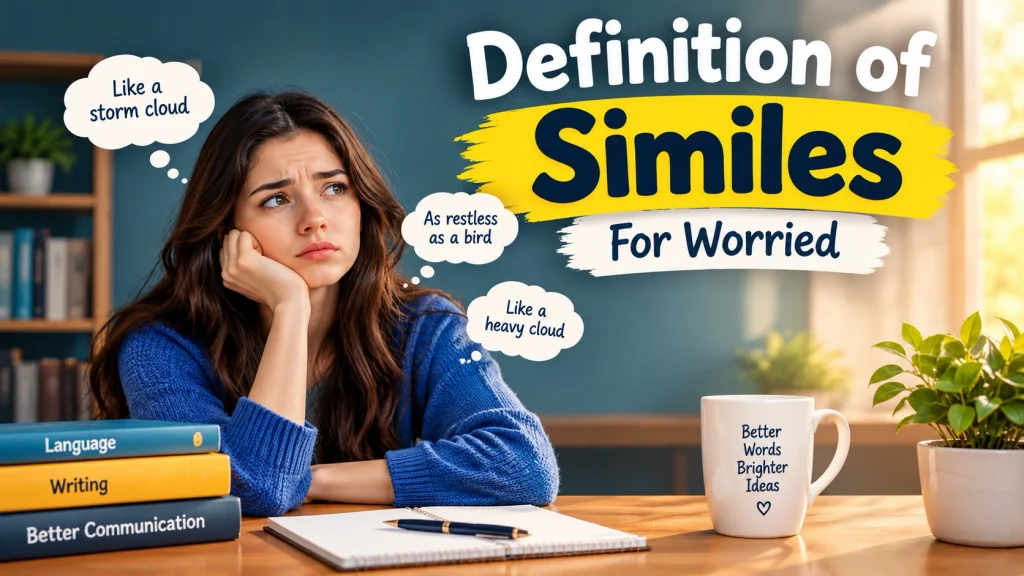
Similes for Worried are creative comparisons that describe the feeling of being worried by connecting it to something familiar. They usually use words such as “like” or “as” to show the comparison.
For example, instead of simply writing, “She was worried,” you could write, “She was as restless as a bird trapped indoors.” The comparison gives readers a clearer picture of her emotional state.
These comparisons can show different forms of worry, including mild concern, nervous anticipation, fear of failure, uncertainty, or intense distress. A strong simile does more than decorate a sentence; it helps readers understand how worry feels and behaves.
What Is a Simile?
A simile is a figure of speech that directly compares two different things by using words such as “like” or “as.” Writers use similes to make descriptions more vivid, emotional, and memorable.
Example
- His worry was like a dark cloud following him everywhere.
- She was as restless as a bird searching for an escape.
- My thoughts raced like horses across an open field.
- He felt like a sailor watching a storm approach.
- Her anxiety clung to her like a wet coat.
A simile differs from a metaphor because a simile makes the comparison explicit, while a metaphor directly identifies one thing with another.
Why Use Similes for Worry in Writing?
- Create vivid imagery: A strong comparison helps readers visualize an invisible emotion.
- Show emotional intensity: You can distinguish mild concern from overwhelming worry.
- Make writing memorable: Fresh comparisons stay in the reader’s mind longer than plain descriptions.
- Build atmosphere: A stormy, dark, or restless comparison can create tension.
- Show rather than tell: Instead of saying someone feels worried, you can demonstrate how that worry affects them.
- Add personality: A humorous comparison can make mild worry feel playful rather than dramatic.
- Improve storytelling: Emotional comparisons can make characters feel more realistic.
- Strengthen poetry: Similes can add rhythm, imagery, and emotional depth.
- Clarify abstract emotions: Worry has no physical shape, but a comparison gives it something readers can imagine.
- Create emotional connection: Familiar images can help readers recognize feelings they have experienced themselves.
Effective similes commonly create vivid imagery and emotional impact, but writers should avoid overusing them or relying on tired comparisons.
Types of Similes
Similes for worry can take several forms. Some focus on nature, while others compare worry with animals, physical sensations, objects, or movement. Choosing the right type helps you match the comparison to the mood of your writing.
Nature-Based Similes
Nature-based similes compare worry with storms, clouds, waves, wind, darkness, or other natural forces. They work especially well when you want to create a serious or dramatic mood.
Example
- Her worry was like a storm gathering beyond the horizon.
- His thoughts rolled like thunder inside his head.
- Anxiety hung over her as heavily as a rain-filled cloud.
- His uncertainty moved like a cold wind through his mind.
Animal-Based Similes
Animal comparisons can make worry easier to visualize. Restless birds, trapped mice, alert deer, and nervous horses can represent different kinds of anxious behavior.
Example
- She was as restless as a bird trapped in a small room.
- His thoughts darted like frightened mice.
- He watched the door like a deer sensing danger nearby.
- Her nerves jumped like a rabbit hearing footsteps.
Object-Based Similes
Objects can represent the pressure, weight, repetition, or persistence of worry. These comparisons work well in everyday writing and storytelling.
Example
- His worry sat on his chest like a heavy backpack.
- Her thoughts spun like a broken clock.
- Anxiety followed him like an alarm that refused to stop ringing.
- His concern felt like a knot pulled tight with every passing minute.
Movement-Based Similes
Movement-based similes describe how worry behaves inside the mind or body. They are useful when you want to show restless thoughts, uncertainty, or emotional pressure.
Example
- Her thoughts raced like runners chasing a finish line.
- His worry bounced like a ball trapped inside a narrow room.
- Anxiety crept through him like a slow-moving shadow.
- Her doubts circled like birds above an empty field.
Writing Tips and Common Mistakes
Useful Tips
- Match the simile to the emotion: Use gentle imagery for mild concern and stronger imagery for intense worry.
- Choose a clear connection: The comparison should share a recognizable quality with worry.
- Use sensory details: Think about sounds, movement, weight, temperature, darkness, or pressure.
- Avoid predictable comparisons: Try to move beyond common phrases such as “nervous as a cat.”
- Keep the comparison understandable: Creativity should not make the meaning confusing.
- Consider your audience: Simple comparisons often work better for younger readers.
- Match the tone: A humorous story may need a playful simile, while a serious scene may need darker imagery.
- Use similes selectively: Too many comparisons can distract readers from the main idea.
- Read the sentence aloud: A good simile should sound natural within the sentence.
- Connect the image to the character: The comparison should reveal something about the person experiencing worry.
Common Mistakes to Avoid
- Using a cliché: “He was nervous as a cat” may feel predictable. Try a fresher comparison.
- Making an unclear comparison: Avoid images that have no obvious connection to worry.
- Mixing comparisons: “Her worry was like a storm and a ticking bomb and a racing horse” creates a crowded image.
- Overexplaining: Let the comparison do some of the work instead of explaining every detail.
- Using the wrong intensity: Comparing mild concern to a devastating hurricane may sound exaggerated.
- Ignoring context: A playful simile may feel inappropriate in a serious scene.
- Repeating the same image: Using “storm” in every description makes your writing less varied.
- Forgetting grammar: Make sure the sentence structure supports the comparison naturally.
50 Similes For Worried (Main Section)
Worried Like a Storm Gathering on the Horizon
Meaning: Feeling increasingly concerned as an uncertain situation approaches.
Detailed Explanation: This simile compares growing worry to a storm that slowly forms before it arrives. It works well when someone knows that a difficult event may happen but cannot yet see exactly how it will unfold.
Tone: Dramatic and suspenseful.
Examples:
- Her worry was like a storm gathering on the horizon before the interview.
- His concern grew like a storm gathering beyond the distant hills.
- The uncertainty felt like a storm gathering over an otherwise peaceful day.
Worried Like a Bird Trapped in a Room
Meaning: Feeling restless, nervous, and unable to find a way out of a problem.
Detailed Explanation: A trapped bird constantly searches for an escape. This image captures the restless behavior that often comes with persistent worry.
Tone: Anxious and vivid.
Examples:
- She was as worried as a bird trapped in a room.
- His thoughts fluttered like a bird trapped behind a closed window.
- I felt like a bird trapped indoors while waiting for the results.
Worried Like a Clock Ticking in an Empty Room
Meaning: Feeling increasingly nervous while waiting.
Detailed Explanation: A ticking clock can make every passing second noticeable. This simile captures the pressure and tension that grow during uncertain waiting.
Tone: Suspenseful and tense.
Examples:
- His worry was like a clock ticking in an empty room.
- The waiting felt like a clock ticking louder with every second.
- Her thoughts sounded like a clock ticking through the silent night.
Worried Like a Sailor Watching a Darkening Sea
Meaning: Feeling concerned about danger that may be approaching.
Detailed Explanation: A sailor watching a darkening sea knows that changing conditions could bring trouble. The image represents uncertainty combined with anticipation.
Tone: Serious and dramatic.
Examples:
- He looked as worried as a sailor watching a darkening sea.
- Her expression carried the fear of a sailor watching dark clouds gather.
- I waited like a sailor watching the sea turn black.
Worried Like a Rabbit Hearing Footsteps
Meaning: Feeling suddenly alert because something seems threatening.
Detailed Explanation: A rabbit hearing unexpected footsteps may become extremely alert. This simile suits moments when worry appears suddenly.
Tone: Nervous and immediate.
Examples:
- He became as worried as a rabbit hearing footsteps nearby.
- She froze like a rabbit hearing footsteps behind her.
- His attention snapped into place like a rabbit hearing danger.
Worried Like a Shadow That Would Not Leave
Meaning: Feeling persistent worry that follows someone everywhere.
Detailed Explanation: A shadow stays close to its owner, making it a useful image for worry that refuses to disappear.
Tone: Poetic and serious.
Examples:
- Her worry followed her like a shadow that would not leave.
- The thought stayed with him like a shadow throughout the day.
- Anxiety clung to her like a shadow beneath the afternoon sun.
Worried Like a Candle Flickering in the Wind
Meaning: Feeling emotionally unstable or uncertain.
Detailed Explanation: A flickering candle may go out at any moment. This creates an image of fragile confidence and constant uncertainty.
Tone: Poetic and delicate.
Examples:
- His confidence shook like a candle flickering in the wind.
- She felt as worried as a candle flickering before a storm.
- Their hope trembled like a candle in a cold breeze.
Worried Like a Mouse Near a Cat
Meaning: Feeling vulnerable because danger seems close.
Detailed Explanation: A mouse near a cat represents helplessness and heightened awareness. The simile works when a person feels exposed or threatened.
Tone: Tense and slightly humorous.
Examples:
- He looked as worried as a mouse near a cat.
- She felt like a mouse hiding while danger waited nearby.
- His nervous glance made him seem like a mouse near a hunting cat.
Worried Like Waves Before a Hurricane
Meaning: Feeling an intense and growing emotional disturbance.
Detailed Explanation: Waves become increasingly powerful before a major storm. This comparison describes worry that builds until it becomes difficult to control.
Tone: Dramatic and powerful.
Examples:
- Her thoughts rose like waves before a hurricane.
- His worry crashed through his mind like waves before a hurricane.
- The uncertainty grew like restless waves beneath a dark sky.
Worried Like a Runner Waiting for the Starting Gun
Meaning: Feeling nervous immediately before an important event.
Detailed Explanation: A runner may feel excitement and tension while waiting for the race to begin. This simile fits interviews, exams, performances, competitions, and other major moments.
Tone: Energetic and tense.
Examples:
- She was as worried as a runner waiting for the starting gun.
- He sat there like a runner waiting for the race to begin.
- My nerves felt like a runner’s muscles just before the starting signal.
Worried Like a Kite Tangled in Power Lines
Meaning: Feeling stuck in a difficult situation.
Detailed Explanation: A tangled kite cannot move freely. This image captures the feeling of having many thoughts but no clear way forward.
Tone: Vivid and uneasy.
Examples:
- His mind felt like a kite tangled in power lines.
- She was as worried as a kite caught where it could not escape.
- My thoughts remained tangled like a kite in a storm.
Worried Like a Door Waiting for a Knock
Meaning: Feeling uncertain about what is about to happen.
Detailed Explanation: A closed door creates mystery because someone may knock at any moment. This comparison emphasizes anticipation.
Tone: Quiet and suspenseful.
Examples:
- Her heart felt like a door waiting for a knock.
- He waited as anxiously as a door waiting for an unexpected visitor.
- The silence felt like a door waiting for the sound of bad news.
Worried Like a Train Approaching Too Fast
Meaning: Feeling that a problem is moving quickly toward you.
Detailed Explanation: A fast-approaching train creates urgency and fear. This simile works when someone feels unable to stop an approaching problem.
Tone: Urgent and dramatic.
Examples:
- His worry came like a train approaching too fast.
- The deadline felt like a train rushing toward her.
- Anxiety grew as quickly as a train gaining speed.
Worried Like Leaves Trembling Before a Storm
Meaning: Feeling nervous before something uncertain happens.
Detailed Explanation: Trembling leaves suggest vulnerability and anticipation. The image creates a softer form of anxiety than a violent storm comparison.
Tone: Poetic and gentle.
Examples:
- She was as nervous as leaves trembling before a storm.
- His hands shook like leaves trembling in a cold wind.
- Her confidence fluttered like leaves before heavy rain.
Worried Like a Phone Waiting for a Difficult Message
Meaning: Feeling tense while expecting uncertain news.
Detailed Explanation: Waiting for an important message can make every notification feel significant. This comparison fits modern everyday situations.
Tone: Relatable and anxious.
Examples:
- He felt like a phone waiting for a difficult message.
- Her attention stayed fixed like a phone waiting for an important notification.
- I was as restless as a phone waiting for bad news.
Worried Like a Bee Trapped Behind Glass
Meaning: Feeling busy, frustrated, and unable to solve a problem.
Detailed Explanation: A trapped bee continues moving without finding an exit. This image represents restless thinking and frustration.
Tone: Energetic and uneasy.
Examples:
- His thoughts buzzed like a bee trapped behind glass.
- She moved around like a bee searching for an escape.
- My mind felt like a trapped bee circling the same problem.
Worried Like a Boat Without an Anchor
Meaning: Feeling unstable and uncertain.
Detailed Explanation: A boat without an anchor can drift with the water. This simile represents a person who lacks certainty or control.
Tone: Reflective and emotional.
Examples:
- He felt as worried as a boat without an anchor.
- Her thoughts drifted like a boat without an anchor.
- I felt unsteady, like a boat floating without an anchor.
Worried Like a Student Before Opening Exam Results
Meaning: Feeling nervous about an uncertain outcome.
Detailed Explanation: Waiting to see exam results can create a mixture of hope and fear. This simile connects worry with anticipation.
Tone: Relatable and tense.
Examples:
- She was as worried as a student before opening exam results.
- He waited like a student staring at a sealed results envelope.
- My stomach twisted like a student waiting for an important score.
Worried Like a Deer in Headlights
Meaning: Feeling shocked, frightened, and unable to react.
Detailed Explanation: This familiar image describes someone who suddenly faces something intimidating and struggles to decide what to do.
Tone: Dramatic and immediate.
Examples:
- He looked as worried as a deer in headlights.
- She stood there like a deer caught in bright headlights.
- The unexpected question left him frozen like a deer in headlights.
Worried Like a Hen Watching the Sky
Meaning: Feeling alert because danger may arrive unexpectedly.
Detailed Explanation: The image of an animal watching the sky suggests constant attention and concern about what may happen next.
Tone: Alert and slightly playful.
Examples:
- She watched the sky like a worried hen expecting trouble.
- He looked as nervous as a hen watching dark clouds.
- Her constant checking made her seem like a hen waiting for danger.
Worried Like a Tightrope Walker in a Strong Wind
Meaning: Feeling that one small mistake could cause trouble.
Detailed Explanation: A tightrope walker must maintain balance while dealing with uncertainty. The simile captures pressure and fear of making a mistake.
Tone: Dramatic and suspenseful.
Examples:
- He felt as worried as a tightrope walker in a strong wind.
- Her decision-making became like a tightrope walk above a deep valley.
- I felt like a tightrope walker trying not to make one wrong move.
Worried Like Thunder Hiding Behind the Clouds
Meaning: Feeling that trouble is present even though it has not appeared yet.
Detailed Explanation: Thunder can remain hidden before a storm breaks. This image represents worry about a possible future event.
Tone: Mysterious and dramatic.
Examples:
- His worry was like thunder hiding behind the clouds.
- She carried a fear that rumbled like distant thunder.
- The uncertainty felt like thunder waiting behind dark clouds.
Worried Like a Locked Door With No Key
Meaning: Feeling trapped because there seems to be no solution.
Detailed Explanation: A locked door represents an obstacle, while the missing key represents a solution that cannot yet be found.
Tone: Serious and symbolic.
Examples:
- Her problem felt like a locked door with no key.
- He was as worried as someone standing before a locked door.
- The unanswered question became like a locked door in his mind.
Worried Like a Bird Before Winter
Meaning: Feeling concerned about an uncertain future.
Detailed Explanation: A bird preparing for harsh weather suggests anticipation and concern about what lies ahead.
Tone: Poetic and thoughtful.
Examples:
- She was as worried as a bird before winter.
- His mind prepared for trouble like a bird sensing the cold.
- The future seemed uncertain, like winter approaching a small bird.
Worried Like Sand Slipping Through Fingers
Meaning: Feeling that control is slowly disappearing.
Detailed Explanation: Sand cannot easily be held in one place. This comparison works when a person fears losing control over a situation.
Tone: Poetic and reflective.
Examples:
- His sense of control slipped away like sand through his fingers.
- She felt as worried as someone watching time disappear like falling sand.
- The opportunity seemed to vanish like sand slipping through her hands.
Worried Like a Balloon Pulled in Every Direction
Meaning: Feeling emotionally stretched by conflicting concerns.
Detailed Explanation: A balloon pulled from different directions represents a mind struggling with multiple pressures.
Tone: Playful but anxious.
Examples:
- Her thoughts stretched like a balloon pulled in every direction.
- He felt as worried as a balloon caught between opposing winds.
- My attention bounced around like a balloon pushed by changing currents.
Worried Like a Puzzle With One Missing Piece
Meaning: Feeling unable to relax because something important remains unknown.
Detailed Explanation: A nearly complete puzzle can remain unsatisfying when one essential piece is missing. The comparison captures uncertainty.
Tone: Thoughtful and relatable.
Examples:
- His mind felt like a puzzle with one missing piece.
- She was as restless as someone holding an incomplete puzzle.
- The unanswered question remained like the missing piece of a puzzle.
Worried Like a Snowflake Near a Flame
Meaning: Feeling fragile and threatened.
Detailed Explanation: A snowflake can disappear quickly near heat. This image describes vulnerability and fear that circumstances may change suddenly.
Tone: Delicate and dramatic.
Examples:
- She felt as worried as a snowflake near a flame.
- His confidence seemed fragile like a snowflake near fire.
- Her calmness melted like a snowflake near a warm flame.
Worried Like a Clock With No Hands
Meaning: Feeling uncertain because you cannot tell what will happen or when.
Detailed Explanation: A clock without hands cannot show the time. This image represents confusion, uncertainty, and lack of direction.
Tone: Mysterious and reflective.
Examples:
- His future felt as uncertain as a clock with no hands.
- She was worried like someone waiting beside a clock that could not tell time.
- The situation felt directionless like a clock without hands.
Worried Like a Match Near Dry Grass
Meaning: Feeling that a small problem could quickly become serious.
Detailed Explanation: A match near dry grass represents potential danger. The simile works when someone fears that one small event may trigger a larger problem.
Tone: Tense and dramatic.
Examples:
- His worry was like a match near dry grass.
- She treated every small mistake like a spark near dry grass.
- The tension felt as dangerous as a match near a field of dry grass.
Worried Like a Runner Looking Over His Shoulder
Meaning: Feeling concerned that trouble is following you.
Detailed Explanation: Looking over your shoulder suggests fear that something unwanted may be close behind.
Tone: Suspenseful and urgent.
Examples:
- He moved like a runner looking over his shoulder.
- Her worry followed her like footsteps behind a frightened runner.
- I felt as tense as someone constantly checking what was behind him.
Worried Like a Spider Waiting for the Web to Shake
Meaning: Feeling alert for signs that something is wrong.
Detailed Explanation: A spider can respond quickly when its web moves. This simile describes a person who constantly watches for warning signs.
Tone: Suspenseful and unusual.
Examples:
- She stayed alert like a spider waiting for its web to shake.
- His attention remained fixed like a spider sensing movement.
- He watched every detail as nervously as a spider waiting for a signal.
Worried Like a Balloon Losing Air
Meaning: Feeling hope or confidence slowly disappear.
Detailed Explanation: A balloon gradually loses its shape as air escapes. This image represents confidence fading under pressure.
Tone: Sad and reflective.
Examples:
- Her confidence faded like a balloon losing air.
- His optimism seemed to shrink like a balloon with a slow leak.
- I felt my hope disappear like air escaping from a balloon.
Worried Like a Candle Beside an Open Window
Meaning: Feeling vulnerable to sudden change.
Detailed Explanation: A candle near an open window may flicker or go out when the wind changes. This creates an image of fragile calm.
Tone: Gentle and poetic.
Examples:
- Her confidence was like a candle beside an open window.
- He felt as vulnerable as a candle exposed to a sudden breeze.
- Their peace flickered like a candle near an open window.
Worried Like a Horse Hearing Distant Thunder
Meaning: Feeling nervous because trouble may be approaching.
Detailed Explanation: Distant thunder can signal an approaching storm. The comparison captures early warning and growing concern.
Tone: Natural and suspenseful.
Examples:
- He became as nervous as a horse hearing distant thunder.
- Her mind reacted like a horse sensing a storm.
- The approaching deadline made him restless like a horse before thunder.
Worried Like a Passenger Watching a Delayed Departure Board
Meaning: Feeling uncertain while waiting for important information.
Detailed Explanation: A changing departure board creates uncertainty for travelers. This modern comparison fits situations involving waiting and incomplete information.
Tone: Relatable and tense.
Examples:
- She looked as worried as a passenger watching a delayed departure board.
- He waited like a traveler hoping the schedule would change.
- The uncertainty felt like staring at a departure board that kept changing.
Worried Like a Compass Spinning Without Direction
Meaning: Feeling confused and unable to decide what to do.
Detailed Explanation: A compass should provide direction, but a spinning needle offers no certainty. This makes it a useful image for mental confusion.
Tone: Reflective and uncertain.
Examples:
- His thoughts spun like a compass without direction.
- She felt as worried as a traveler holding a useless compass.
- My mind turned like a compass spinning in a magnetic storm.
Worried Like a Nest Before a Storm
Meaning: Feeling unsettled when trouble may be near.
Detailed Explanation: A nest represents safety, while a storm represents disruption. Together, they create a strong image of fragile security.
Tone: Protective and dramatic.
Examples:
- Her heart felt like a nest before a storm.
- The family waited as nervously as a nest facing strong winds.
- His peaceful mood disappeared like calm air before a storm.
Worried Like Ink Spreading Through Water
Meaning: Feeling that worry is gradually taking over your thoughts.
Detailed Explanation: Ink spreads quickly through water, making it difficult to contain. This comparison shows how one concern can expand into many worries.
Tone: Poetic and emotional.
Examples:
- Her worry spread like ink through water.
- One small doubt grew like ink spreading across a clear page.
- His thoughts darkened like ink dissolving through water.
Worried Like a Doorbell in a Silent House
Meaning: Feeling startled and tense when something unexpected happens.
Detailed Explanation: A sudden doorbell can break complete silence and immediately demand attention. The image works for sudden concern.
Tone: Suspenseful and vivid.
Examples:
- The unexpected news struck him like a doorbell in a silent house.
- Her nerves jumped like a doorbell ringing at midnight.
- The sudden call made him feel as worried as someone alone in a silent house.
Worried Like a Firefly Searching for Darkness
Meaning: Feeling unsettled while searching for a safe place or answer.
Detailed Explanation: A firefly moving through changing surroundings creates an image of uncertainty and searching.
Tone: Poetic and imaginative.
Examples:
- Her thoughts wandered like a firefly searching through the night.
- He felt as uncertain as a firefly moving through unfamiliar darkness.
- My worry drifted like a firefly searching for somewhere safe.
Worried Like a Drum Before a Parade
Meaning: Feeling excited, nervous, and full of anticipation.
Detailed Explanation: A drum creates rhythmic tension before an event begins. This comparison works when worry mixes with excitement.
Tone: Energetic and anticipatory.
Examples:
- Her heart beat like a drum before a parade.
- He felt as nervous as a drummer waiting for the signal.
- The anticipation pulsed like a drum in the distance.
Worried Like a Seed Beneath Frozen Ground
Meaning: Feeling trapped while waiting for difficult conditions to change.
Detailed Explanation: A seed beneath frozen ground cannot grow until conditions improve. This represents patience mixed with uncertainty.
Tone: Hopeful and reflective.
Examples:
- His hope felt like a seed beneath frozen ground.
- She was as worried as a seed waiting beneath the winter soil.
- Her plans remained hidden like a seed beneath frozen earth.
Worried Like a Boat Hearing Distant Fog Horns
Meaning: Feeling uncertain about hidden dangers.
Detailed Explanation: A fog horn signals something nearby even when visibility remains poor. This creates a strong image of uncertainty.
Tone: Mysterious and tense.
Examples:
- He felt as worried as a boat hearing distant fog horns.
- The warning sounded like a fog horn in his uncertain mind.
- She waited like a sailor hearing danger through thick fog.
Worried Like a Snow Globe Before It Settles
Meaning: Feeling mentally unsettled after sudden confusion or change.
Detailed Explanation: When a snow globe shakes, everything inside moves chaotically before slowly becoming still. This represents a mind trying to regain calm.
Tone: Gentle and imaginative.
Examples:
- Her thoughts were like a snow globe before it settled.
- He felt as unsettled as a shaken snow globe.
- My mind swirled like snow inside a globe after a sudden shake.
Worried Like a Messenger Carrying an Unopened Letter
Meaning: Feeling nervous because important information has not yet been revealed.
Detailed Explanation: An unopened letter may contain good or bad news. The uncertainty creates a natural image of anticipation.
Tone: Suspenseful and thoughtful.
Examples:
- He felt like a messenger carrying an unopened letter.
- She was as worried as someone holding news they had not yet read.
- The envelope weighed on him like an unopened letter full of uncertainty.
Worried Like a Window During Heavy Rain
Meaning: Feeling exposed while watching trouble unfold outside.
Detailed Explanation: A window separates a person from the storm but still allows them to see it. This simile suits someone who watches a problem develop without knowing how to respond.
Tone: Melancholic and atmospheric.
Examples:
- Her mind felt like a window during heavy rain.
- He watched the situation like a window facing a storm.
- Her worry blurred her thoughts like rain covering a glass window.
Worried Like a Student Hearing the Final Bell
Meaning: Feeling pressure when time has almost run out.
Detailed Explanation: A final bell signals that an important period has ended. This comparison captures last-minute worry and urgency.
Tone: Urgent and relatable.
Examples:
- He felt as worried as a student hearing the final bell.
- Her thoughts raced like a student rushing before the bell.
- The deadline sounded like a final bell inside his mind.
Worried Like a Lighthouse Waiting for the Storm
Meaning: Feeling responsible while expecting difficult conditions.
Detailed Explanation: A lighthouse remains in place while storms pass around it. The comparison represents steady concern during uncertain circumstances.
Tone: Strong and dramatic.
Examples:
- She stood as worried as a lighthouse waiting for the storm.
- His patience remained like a lighthouse beneath dark clouds.
- He watched the horizon like a lighthouse expecting rough seas.
Worried Like a Thread Pulled Too Tight
Meaning: Feeling emotionally strained and close to breaking.
Detailed Explanation: A thread can withstand only so much tension. This simile clearly represents pressure that keeps increasing.
Tone: Intense and emotional.
Examples:
- Her nerves felt like a thread pulled too tight.
- He was as tense as a thread stretched to its limit.
- The pressure tightened around her as a thread pulled too far.
Worried Like a Fire Alarm Waiting for Smoke
Meaning: Feeling constantly ready for something to go wrong.
Detailed Explanation: A fire alarm exists to respond to danger. This image represents a mind that remains constantly alert.
Tone: Alert and slightly humorous.
Examples:
- His mind was like a fire alarm waiting for smoke.
- She stayed as alert as an alarm expecting trouble.
- My thoughts kept reacting like a fire alarm searching for danger.
Worried Like a Traveler Without a Map
Meaning: Feeling uncertain because you do not know which direction to take.
Detailed Explanation: A traveler without a map may not know where to go next. This represents uncertainty, confusion, and lack of guidance.
Tone: Reflective and relatable.
Examples:
- He felt as worried as a traveler without a map.
- Her future seemed like a road faced by a traveler without directions.
- I wandered through the problem like a traveler without a map.
Worried Like a Raindrop on a Window Edge
Meaning: Feeling fragile and uncertain about what happens next.
Detailed Explanation: A raindrop on the edge of a window may slide downward at any moment. The image captures hesitation and vulnerability.
Tone: Poetic and delicate.
Examples:
- Her confidence hung like a raindrop on a window edge.
- He felt as fragile as a raindrop about to fall.
- The decision balanced like a raindrop at the edge of glass.
Worried Like a Dog Hearing Thunder
Meaning: Feeling nervous because something frightening may happen.
Detailed Explanation: Thunder can make some dogs restless or frightened. This familiar image effectively represents sudden anxiety.
Tone: Familiar and emotional.
Examples:
- He was as worried as a dog hearing thunder.
- Her nerves reacted like a dog startled by a sudden boom.
- The unexpected sound made him restless like a dog during a storm.
Worried Like a Feather Hovering Above a Flame
Meaning: Feeling delicate, vulnerable, and close to danger.
Detailed Explanation: A feather can be easily moved by air and can burn quickly near a flame. This creates a strong image of fragile security.
Tone: Delicate and dramatic.
Examples:
- She felt as worried as a feather hovering above a flame.
- His confidence seemed as fragile as a feather near fire.
- The situation balanced like a feather drifting above a flame.
Worried Like a Runner Staring at a Steep Hill
Meaning: Feeling nervous about a difficult task that lies ahead.
Detailed Explanation: A steep hill represents a challenge that requires effort. The comparison works well for exams, difficult projects, conversations, and major decisions.
Tone: Motivational and tense.
Examples:
- He looked as worried as a runner staring at a steep hill.
- She faced the assignment like a runner facing a difficult climb.
- The upcoming challenge stood before him like a steep hill.
Worried Like a Bell Waiting for the Next Ring
Meaning: Feeling tense while expecting another event.
Detailed Explanation: A bell that may ring at any moment represents anticipation and uncertainty.
Tone: Suspenseful and simple.
Examples:
- She felt like a bell waiting for the next ring.
- His nerves stayed alert like a bell expecting another sound.
- The waiting made him as tense as a bell before it rings.
Worried Like Fog Covering an Unknown Road
Meaning: Feeling uncertain because the future remains unclear.
Detailed Explanation: Fog hides what lies ahead, making travel difficult. This creates a natural comparison for uncertainty.
Tone: Mysterious and reflective.
Examples:
- His future looked like a road covered in fog.
- She felt as worried as a traveler entering an unknown road through thick fog.
- The decision seemed hidden like a road disappearing into mist.

Top 10 Similes For Worried
| Simile | Meaning | Tone |
| Worried like a storm gathering on the horizon | Growing concern about an approaching problem | Dramatic |
| Worried like a bird trapped in a room | Restless and unable to escape worry | Anxious |
| Worried like a clock ticking in an empty room | Nervousness while waiting | Suspenseful |
| Worried like a sailor watching a darkening sea | Concern about approaching danger | Serious |
| Worried like a shadow that would not leave | Persistent worry that follows someone | Poetic |
| Worried like a puzzle with one missing piece | Anxiety caused by uncertainty | Thoughtful |
| Worried like a tightrope walker in a strong wind | Fear of making a mistake | Dramatic |
| Worried like ink spreading through water | Worry gradually taking over the mind | Emotional |
| Worried like a traveler without a map | Confusion about what direction to take | Reflective |
| Worried like a thread pulled too tight | Emotional pressure reaching its limit | Intense |
The strongest choice depends on the context. A storm comparison can create drama, while a puzzle comparison can express uncertainty more gently. A traveler without a map can suggest confusion, whereas a thread pulled too tight can emphasize pressure. The goal is not simply to make a sentence sound poetic; it is to choose an image that communicates the exact kind of worry you want readers to understand.
Conclusion :
Similes for Worry give writers a creative way to express an emotion that can otherwise feel difficult to describe. Worry may feel like a gathering storm, a ticking clock, a tangled kite, a missing puzzle piece, or a thread pulled too tight. Each comparison highlights a different part of the emotional experience, from uncertainty and anticipation to pressure and fear. When you choose an image that naturally matches your character, situation, and tone, your writing becomes clearer and more engaging.
Strong similes also help readers visualize emotions rather than simply being told what a character feels. Remember to keep your comparisons fresh, understandable, and relevant. Avoid filling every sentence with figurative language. One carefully chosen comparison can often create more impact than several unrelated ones. With practice, these Similes For Worried can help you write stronger stories, poems, essays, descriptions, and everyday expressions.
FAQs
What is a simile for being worried?
A simile for being worried compares worry with something familiar by using words such as “like” or “as.” For example, “She was as restless as a bird trapped in a room” compares emotional restlessness with a trapped bird.
What is a good simile for someone who is very worried?
“His worry was like a storm gathering on the horizon” works well for intense or growing concern. It suggests that the person senses a difficult situation approaching and cannot easily stop thinking about it.
What is a poetic simile for worried?
A poetic option is “Her worry followed her like a shadow that would not leave.” It presents worry as something persistent that remains close even when the person tries to move forward.
How can I describe nervousness with a simile?
Compare nervousness with something restless or unpredictable. For example, “His thoughts raced like horses across an open field” shows mental activity and difficulty settling down.
What is a simile for anxious thoughts?
“Her thoughts spread like ink through water” can describe anxious thoughts that gradually take over the mind. The image suggests that one concern can expand into many related worries.
What is a simile for worrying about the future?
“His future felt like a fog-covered road” works well because fog hides what lies ahead. It captures uncertainty without saying exactly what will happen.
Can similes make emotional writing stronger?
Yes. A well-chosen simile can make an abstract emotion easier to visualize. Writers often use similes to create vivid imagery, emphasize feelings, and make descriptions more memorable.
What is the difference between a simile and a metaphor?
A simile makes an explicit comparison, commonly with “like” or “as.” A metaphor makes a direct comparison without those linking words. For example, “Her worry was like a storm” is a simile, while “Her worry was a storm” is a metaphor.
Should I use many similes in one paragraph?
Usually, you should use them selectively. Too many comparisons can make writing feel crowded or distract readers. A few relevant and original similes can create stronger imagery than a long sequence of unrelated comparisons.
How do I create my own similes for worry?
First, identify the exact type of worry you want to show. Then think about something that behaves in a similar way. For growing worry, consider a storm; for uncertainty, consider fog; for pressure, consider a tightly stretched thread. Finally, connect the two ideas naturally with “like” or “as.”
Here is the polished conclusion, FAQ section, and a character-compliant meta description for Similes For Worried.
How can I describe nervousness with a simile?
You can describe nervousness by comparing it with something restless, unpredictable, or constantly moving. For example, “His thoughts raced like horses across an open field” shows that his mind cannot settle. Choose an image that matches the intensity of the nervousness and fits naturally with the surrounding sentence or paragraph.
What is a simile for anxious thoughts?
“Her thoughts spread like ink through water” is a strong simile for anxious thoughts. The image suggests that one small concern can gradually expand until it affects the entire mind. This comparison works particularly well when you want to show how worry grows, becomes difficult to control, or influences several thoughts at once.
What is a simile for worrying about the future?
“His future felt like a fog-covered road” can effectively describe worry about the future. Fog hides what lies ahead, creating uncertainty about the next step. The comparison works well because it does not assume what will happen. Instead, it focuses on the character’s inability to clearly see or predict the future.
Can similes make emotional writing stronger?
Yes, similes can make emotional writing more vivid by connecting an abstract feeling with something readers already understand. A carefully chosen comparison can communicate intensity, uncertainty, fear, or nervousness more effectively than a simple statement. The key is to choose an image that fits the emotion, context, audience, and overall tone.
What is the difference between a simile and a metaphor?
A simile directly compares two different things using words such as “like” or “as.” For example, “Her worry was like a storm” is a simile. A metaphor makes the comparison more directly, such as “Her worry was a storm.” Both devices create imagery, but they structure the comparison differently.
Should I use many similes in one paragraph?
You should use similes thoughtfully rather than filling every sentence with comparisons. Too many similes can make writing feel crowded and reduce the impact of each image. One strong, relevant comparison can often communicate an emotion more effectively than several unrelated ones. Always consider clarity, flow, context, and the reader’s experience.
How can I create my own similes for worried?
Start by identifying the exact type of worry you want to describe. Then think of something that behaves in a similar way. Growing worry might resemble a gathering storm, uncertainty might resemble fog, and pressure might resemble a tightly stretched thread. Connect the two ideas naturally with “like” or “as” and keep the comparison easy to understand.
Meta Description
Discover Similes For Worried with clear meanings, creative examples, and tips to describe anxiety, nervousness, and uncertainty vividly.

