“That’s mean” vs. “that means” is a common grammar confusion for English learners. Both expressions may look similar, but only “that means” is correct in standard English when explaining what something signifies or implies. Understanding the difference helps you write clearer sentences, speak more naturally, and avoid common grammatical mistakes in everyday conversations, academic writing, and professional communication.
Comparison Overview
The expressions “thats mean” and “that means” look almost identical, but they differ in grammatical correctness. The correct choice depends on the subject, verb, and intended meaning of the sentence.
“That means” is the grammatically correct expression when you want to explain the meaning, result, or implication of something. For example, “The store is closed; that means we need another plan.”
“Thats mean” is incorrect in standard English because “thats” is not the correct spelling of the contraction “that’s,” and “mean” does not agree with the singular subject “that” in this sentence structure.
It is also important to distinguish “that means” from “that’s mean.” The latter is grammatically possible when “mean” describes someone as unkind, as in “That’s mean of you.” The apostrophe and the intended meaning make a difference.
Definition of That’s Mean
“Thats mean” is not a standard, grammatically correct English expression. It usually appears because writers confuse “that means,” “that’s mean,” and “that’s what I mean.”
The problem involves both spelling and grammar.
First, “thats” is not a standard English contraction. The correct contraction is “that’s,” which can mean “that is” or “that has.”
Second, when “that” is the subject of a sentence and the verb means “signifies” or “implies,” the correct form is “means,” not “mean.”
Why Is “That’s Mean” Incorrect?
Consider these examples:
- Incorrect: Thats mean we should leave.
- Correct: That means we should leave.
- Correct: That’s mean of you.
- Correct: That’s what I mean.
The first sentence needs “that means” because it explains a consequence. The second sentence uses “that’s” as a contraction of “that is,” followed by the adjective “mean,” which describes unkind behavior. The third uses a different sentence structure to clarify a point.
Therefore, “that’s mean” should generally be avoided in formal writing, school assignments, emails, and professional communication.
Definition of That Means
“That means” is a correct English expression used to explain what something signifies, indicates, or implies. It can also introduce a result or consequence that follows from a fact or situation.
The expression consists of two parts:
- That: A pronoun referring to a fact, statement, situation, or previously mentioned idea.
- Means: The third-person singular form of the verb “mean,” which describes what something signifies or implies.
For example:
“That means we have to finish the project today.”
In this sentence, “that” refers to an earlier fact or situation, while “means” introduces its consequence.
Examples of “That Means”
- You passed the exam. That means you can graduate.
- The road is blocked. That means we need another route.
- The price increased. That means customers will pay more.
- She has not replied. That means she might be busy.
- The lights are off. That means nobody is home.
In each example, “that means” connects information to its meaning or logical consequence.
Main Differences Between That’s Mean and That Means

The main difference is grammatical correctness. “That means” is correct when explaining what something implies, while “thats mean” is not standard English.
| Feature | That’s Mean | That Means |
| Standard grammar | Incorrect | Correct |
| Spelling | “Thats” lacks an apostrophe if intended as a contraction | Correct spelling |
| Verb agreement | “Mean” does not agree with “that” in this construction | “Means” agrees with the singular subject |
| Meaning | Usually an attempted expression of implication | Explains meaning or consequence |
| Formal writing | Avoid | Appropriate |
| Everyday conversation | Avoid this form | Natural and common |
| Example | That’s mean we are late. | That means we are late. |
The Difference Between “That Means” and “That’s Mean”
This distinction is especially important because “that’s mean” can be correct, even though “thats mean” is not standard.
That means explains information:
“That means he forgot the meeting.”
That’s mean describes unkind behavior:
“That’s mean! You should apologize to her.”
In the second example, “that’s” means “that is,” and “mean” is an adjective describing behavior.
The two expressions serve different grammatical purposes, so you should choose the one that matches your intended message.
Is It “That Means” or “That’s Mean”?
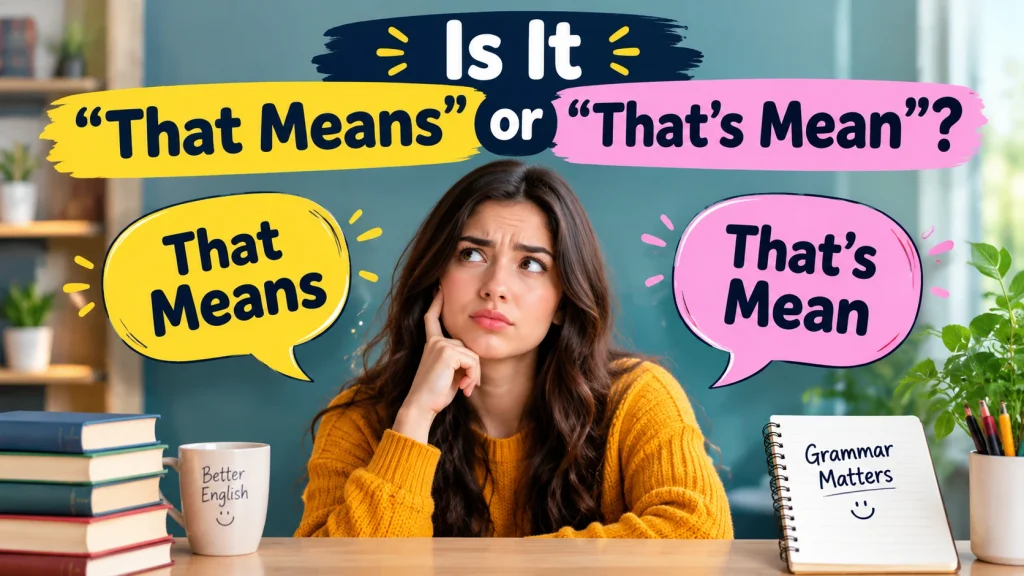
The correct expression depends on what you want to communicate.
Use “that means” when explaining a result, definition, or implication. Use “that’s mean” when describing an action or comment as unkind.
Use “That Means” to Explain a Result
Examples:
- You missed the bus. That means you will arrive late.
- The deadline is tomorrow. That means we must hurry.
- He speaks three languages. That means he is multilingual.
Use “That’s Mean” to Describe Unkind Behavior
Examples:
- That’s mean of you to laugh at him.
- That’s mean! She was only trying to help.
- Making fun of someone’s appearance is mean.
Remember that “that’s mean” is not interchangeable with “that means.” The first describes behavior; the second explains information or a consequence.
Grammar Guide
Understanding subject-verb agreement and contractions makes it easier to use these expressions correctly.
“That means” contains a singular subject and a present-tense verb. In standard English, the verb “mean” takes the ending “-s” when its subject is “that” in this construction.
“That’s mean,” on the other hand, contains a contraction of “that is.” Here, “mean” functions as an adjective rather than the main verb.
How Each Term Is Used in Sentences
Pattern 1: That means + result or explanation
Use this structure to explain what a fact or situation implies.
Examples:
- That means we need more time.
- That means the answer is incorrect.
- That means the machine is working properly.
Pattern 2: That’s mean + description of unkind behavior
Use “that’s mean” when the adjective “mean” describes an action or behavior.
Examples:
- That’s mean of him.
- That’s mean to say about your friend.
- That’s mean, and you should apologize.
Pattern 3: That’s what I mean
Use this expression when confirming or emphasizing the point you are trying to make.
Examples:
- Exactly! That’s what I mean.
- You finally understand what I mean.
- That’s what I mean when I say we need better communication.
These patterns help you distinguish between explaining an implication, describing unkind behavior, and emphasizing an intended message.
Common Mistakes Learners Make
English learners frequently confuse these expressions because they sound similar in conversation.
Mistake 1: Writing “thats” without an apostrophe
Incorrect: Thats a good idea.
Correct: That’s a good idea.
The apostrophe is necessary when “that’s” means “that is” or “that has.”
Mistake 2: Using “mean” instead of “means”
Incorrect: That mean we are ready.
Correct: That means we are ready.
The singular subject “that” requires “means” when the verb expresses what something implies.
Mistake 3: Confusing “that means” with “that’s mean”
Incorrect for explaining a consequence: That’s mean we have to wait.
Correct: That means we have to wait.
However, “That’s mean of you” is correct when describing unkind behavior.
Mistake 4: Using the wrong expression in formal writing
Incorrect: Thats mean the results are final.
Correct: That means the results are final.
Always check both spelling and sentence meaning before submitting formal work.
Simple Rules to Remember
Follow these simple rules to choose the correct expression:
- Use “that means” when explaining what something implies.
- Use “that’s mean” when describing someone’s behavior as unkind.
- Use “that’s” when you mean “that is” or “that has.”
- Use “means” with the singular subject “that” when explaining significance or consequences.
- Never write “thats” as a standard contraction.
- Read the complete sentence to determine whether “mean” is a verb or an adjective.
A helpful memory trick is to replace “that’s” with “that is.” If the sentence still makes sense, the contraction may be correct. For example, “That’s mean of you” becomes “That is mean of you,” which is grammatically acceptable.
However, “That’s mean we must leave” becomes “That is mean we must leave,” which is incorrect. The correct sentence is “That means we must leave.”
Quick Tips for Writing and Speaking
Use these practical tips to improve your English:
- Check the meaning first: Are you explaining a consequence or describing something unkind?
- Look at the subject: When “that” is the subject and the verb means “implies,” write “means.”
- Check the apostrophe: Use “that’s,” not “thats,” when writing the contraction.
- Keep sentences simple: If you are unsure, use a straightforward construction such as “This means we need more time.”
- Read aloud: Hearing the full sentence can help you recognize an awkward grammatical structure.
- Practice common expressions: Learn examples such as “That means a lot,” “That’s what I mean,” and “That’s mean of you.”
Consistent practice will help you choose the right expression naturally.
When to Use Each One
Because “that’s mean” is incorrect in standard English, you should use “that means” or “that’s mean” according to the intended meaning.
When to Use “That Means”
Use “that means” when explaining:
A consequence
“The train is delayed. That means we will arrive late.”
A definition or interpretation
“The word is written in the past tense. That means the action happened earlier.”
A logical conclusion
“She has completed all the requirements. That means she can graduate.”
A business decision
“The budget has been reduced. That means we need to adjust our spending.”
A technical result
“The device is disconnected. That means it cannot send data.”
When to Use “That’s Mean”
Use “that’s mean” when describing behavior that is unkind, hurtful, or inconsiderate.
Examples:
- That’s mean of you to ignore her.
- That’s mean to say about someone.
- That’s mean! You should not make fun of him.
- Telling that embarrassing story was mean.
- That’s mean behavior, and it needs to stop.
This expression is more common in informal conversation. In formal writing, you may prefer words such as “unkind,” “cruel,” or “inconsiderate,” depending on the context.
When NOT to Use Each One
Knowing when to avoid an expression is just as important as knowing when to use it.
When Not to Use “That’s Mean”
Avoid “that’s mean” in standard English writing because it combines incorrect contraction spelling with an unsuitable verb form for the intended meaning.
Do not write:
- That’s mean we need help. That’s mean the answer is correct.
- That’s mean she has arrived.
Instead, write:
- That means we need help.
- That means the answer is correct.
- That means she has arrived.
If you intend to describe unkind behavior, write “That’s mean” with the apostrophe.
When Not to Use “That Means”
Do not use “that means” when your intended message is simply that someone has behaved unkindly.
For example:
Incorrect for the intended meaning: That means of you to laugh at him.
Correct: That’s mean of you to laugh at him.
Also, avoid using “that means” when the subject requires a different verb form.
For example:
- Incorrect: These means we need more time.
- Correct: These mean we need more time.
- Correct: That means we need more time.
The subject determines the verb form: “that means” but “these mean.”
When Not to Use “That’s Mean”
Avoid “that’s mean” when explaining a definition, implication, or logical consequence.
For example:
Incorrect for the intended meaning: That’s mean the event is canceled.
Correct: That means the event is canceled.
Always determine whether you are describing behavior or explaining information before selecting the expression.
Which One to Use (Decision Guide)
Choosing the correct expression becomes easy when you identify the meaning of your sentence.
Follow this decision guide:
Step 1: Are you explaining a result or implication?
Use “that means.”
Example: The office is closed. That means we should come back tomorrow.
Step 2: Are you describing unkind behavior?
Use “that’s mean.”
Example: That’s mean of you to laugh at someone who made a mistake.
Step 3: Are you emphasizing your intended point?
Use “that’s what I mean.”
Example: Exactly! That’s what I mean.
Step 4: Are you using “that” with another verb form?
Check whether the subject is singular or plural.
Examples:
- That means we need to leave.
- These mean we need to leave.
Step 5: Are you writing “thats” without an apostrophe?
Correct it to “that’s” if you mean “that is” or “that has.”
The easiest rule is this: Use “that means” for implications, “that’s mean” for unkind behavior, and never use “thats mean” as a standard English expression.
Real-World Practical Examples
The following examples show how the expressions work across education, daily life, business, science, technology, and conversation.
That Means Examples
- Education: The teacher has extended the deadline. That means we have another day to finish the assignment.
- Daily life: It is raining heavily outside. That means we should take an umbrella.
- Business: The company has increased its prices. That means customers will pay more for the same products.
- Science: Water freezes at approximately zero degrees Celsius under standard atmospheric pressure. That means it can turn into ice under those conditions.
- Technology: Your phone battery is at one percent. That means you should charge it soon.
- Writing: The author repeats the same phrase throughout the poem. That means the phrase may have special significance.
- Travel: The flight has been delayed by two hours. That means we will reach our destination later than planned.
- Health and fitness: You have exercised consistently for several weeks. That means you have developed a regular workout routine.
- Finance: Your expenses are higher than your income. That means you may need to revise your budget.
- Conversation: You said you would arrive at six. That means we should be ready by then.
That’s Mean Examples
- School: That’s mean of you to laugh at your classmate for giving the wrong answer.
- Daily life: Taking the last piece of cake without asking anyone was mean.
- Friendship: That’s mean! Your friend was trying to help you.
- Business: Making fun of a new employee for asking questions is mean and unprofessional.
- Online communication: Posting an insulting comment about someone’s appearance is mean.
- Family: That’s mean of you to exclude your brother from the game.
- Conversation: Calling someone a hurtful name is mean, even if you say it was a joke.
- Education: It was mean to spread a rumor about another student.
- Social situations: That’s mean of them to invite everyone except one person just to hurt their feelings.
- Everyday decisions: Refusing to help someone simply because you want to embarrass them is mean.
Incorrect “That’s Mean” Examples and Their Corrections
The following examples illustrate common errors and their correct alternatives.
- Incorrect: Thats mean I need to study.
Correct: That means I need to study. - Incorrect: Thats mean we are late.
Correct: That means we are late. - Incorrect: Thats mean the computer is broken.
Correct: That means the computer is broken. - Incorrect: Thats mean she won the competition.
Correct: That means she won the competition. - Incorrect: Thats mean you were right.
Correct: That means you were right.
These corrections demonstrate why “that means” is the appropriate choice when explaining an implication or result.
Self-Assessment (Fill in the Blanks)
Test your understanding by completing the following 20 sentences. Choose the correct expression or verb form based on the context.
- The shop is closed. That ______ we must return tomorrow.
- You passed the test. That ______ you can move to the next level.
- Laughing at someone who is struggling is ______.
- She has not answered my message. That ______ she might be busy.
- ______ mean of you to spread that rumor.
- The computer has no power. That ______ it will not start.
- He speaks four languages. That ______ he is multilingual.
- Making fun of someone’s mistake is ______.
- The road is blocked. That ______ we need another route.
- ______ mean of them to exclude their friend.
- The weather forecast predicts snow. That ______ schools might close.
- The price has increased. That ______ the product costs more.
- You took his belongings without permission. That’s ______.
- The instructions are unclear. That ______ we should ask for help.
- She has completed the course. That ______ she has met the requirements.
- ______ a thoughtful thing to do.
- The Wi-Fi is disconnected. That ______ we cannot access the internet.
- Insulting someone in public is ______.
- He missed the deadline. That ______ his application may be rejected.
- ______ what I mean when I say we should be kind.
Answers
- means — “That means” explains the consequence of the shop being closed.
- means — Passing the test implies that the student can advance.
- mean — Here, “mean” is an adjective describing unkind behavior.
- means — The lack of a reply may indicate that she is busy.
- That’s — “That’s mean of you” means “That is unkind of you.”
- means — The lack of power explains why the computer will not start.
- means — Speaking four languages implies that he is multilingual.
- mean — “Mean” describes the unkind action.
- means — A blocked road implies that another route is needed.
- That’s — The contraction means “That is.”
- means — The forecast suggests a possible consequence.
- means — The increased price indicates that the product costs more.
- mean — “That’s mean” describes the behavior as unkind.
- means — Unclear instructions imply that clarification is needed.
- means — Completing the course indicates that the requirements have been met.
- That’s — “That’s a thoughtful thing to do” is the correct construction.
- means — A disconnected Wi-Fi connection explains the lack of internet access.
- mean — The adjective describes insulting someone as unkind behavior.
- means — Missing the deadline may have a consequence for the application.
- That’s — The correct expression is “That’s what I mean.”
Final Verdict
The correct choice between “thats mean” and “that means” depends on what you want to say, but “thats mean” is not correct in standard English.
Use “that means” when explaining the significance, result, or consequence of something. For example, “The deadline is today. That means we must finish the work now.”
Use “that’s mean” when describing unkind behavior. For example, “That’s mean of you to make fun of your friend.” Remember that “that’s” is the contraction of “that is” or “that has,” so it requires an apostrophe.
The simplest way to remember the difference is to connect “means” with explanations and “mean” with descriptions of unkind behavior. By checking the meaning, spelling, and grammar of your sentence, you can avoid this common mistake and communicate more clearly in everyday conversations, academic assignments, and professional writing.
Conclusion
Understanding “that’s mean” vs. “that means” helps you communicate more clearly and avoid common English grammar mistakes. Although these expressions look similar, they serve different purposes when written correctly. “That means” is the correct choice when explaining the meaning, result, or consequence of something. For example, “The store is closed. That means we need another option.” On the other hand, “that’s mean” is grammatically correct when describing something unkind, as in “That’s mean of you to say.”
Remember that “thats mean” is not standard English because “thats” lacks the required apostrophe when intended as a contraction, and “mean” is incorrect for expressing an implication in this sentence structure. Use “that’s” when you mean “that is” or “that has,” and use “means” when explaining what something signifies. With these simple rules and regular practice, you can choose the correct expression confidently in conversations, schoolwork, emails, and professional writing.
FAQs
Is “thats mean” grammatically correct?
No, “thats mean” is not grammatically correct in standard English. If you want to explain a result or implication, write “that means.” If you want to describe something as unkind, write “that’s mean.” Remember that “that’s” requires an apostrophe because it is a contraction of “that is” or “that has.”
Is it “that means” or “that mean”?
“That means” is correct when “that” is a singular subject referring to something that signifies or implies a result. For example, “That means we should leave.” However, “that mean” can occur in certain grammatical structures, such as “What does that mean?” because the auxiliary verb “does” takes the base form “mean.”
What does “that means” mean?
“That means” introduces an explanation, interpretation, or consequence of something previously mentioned. For example, “The train is delayed. That means we will arrive late.” The phrase connects a fact or situation to its likely result, making it useful in everyday conversations, academic writing, professional communication, and explanations.
What does “that’s mean” mean?
“That’s mean” usually means “that is unkind” or “that is hurtful.” Here, “that’s” is a contraction of “that is,” and “mean” functions as an adjective. For example, “That’s mean of you to laugh at someone.” It differs from “that means,” which explains an implication or consequence.
Why is “thats mean” incorrect?
“Thats mean” is incorrect in standard English because the contraction “that’s” requires an apostrophe, and “mean” is not the correct verb form for expressing an implication with the singular subject “that.” The correct expression is “that means.” However, when describing unkind behavior, you can write “that’s mean.”
When should I use “that means” in a sentence?
Use “that means” when you want to explain what a fact, statement, or situation implies. For example, “You forgot your password. That means you need to reset it.” The phrase works well when describing consequences, interpreting information, explaining decisions, or clarifying something in everyday and professional communication.
Can I use “that’s mean” in everyday conversation?
Yes, “that’s mean” is grammatically correct in informal conversation when you describe an action or comment as unkind. For example, “That’s mean! She was only trying to help.” In more formal situations, alternatives such as “That is unkind” or “That behavior is inconsiderate” may sound more appropriate.
What is the difference between “that’s mean” and “that means”?
“That’s mean” describes something as unkind, while “that means” explains what something signifies or implies. For example, “That’s mean of you to ignore him” describes hurtful behavior. “That means we should call him” explains a consequence. The apostrophe, verb form, and intended meaning distinguish these expressions.
Is “that means” correct in formal writing?
Yes, “that means” is correct in formal writing when used to explain an implication or consequence. You can use it in essays, reports, emails, and professional documents. For example, “The results are inconclusive. That means further research is necessary.” For a more formal tone, “This indicates that” may also work.
How can I remember whether to use “that means” or “that’s mean”?
Remember that “that means” explains something, while “that’s mean” describes unkind behavior. For example, “That means we are ready” explains a situation, whereas “That’s mean of you” criticizes an unkind action. Also, remember to include the apostrophe in “that’s” and use “means” when explaining implications with “that.”

