
“Did you have” and “did you had” look almost identical, but only one is grammatically correct in standard English. The confusion happens because had is the past form of have, while did already marks a question as past tense. Understanding this simple rule can make your writing and speaking much more accurate. (Correct Wording)
Comparison Overview
The correct expression is “Did you have?” The expression “Did you had?” is grammatically incorrect in standard English.
The key rule is:
Did + subject + base form of the verb
Therefore:
- ✅ Did you have breakfast?
- ✅ Did you have enough time?
- ✅ Did you have a meeting?
- ❌ Did you had breakfast?
- ❌ Did you had enough time?
- ❌ Did you had a meeting?
The reason is that did is the past-tense auxiliary verb in a simple past question. Once did carries the past tense, the main verb stays in its base form. (grammarprecision.com)
| Expression | Correct? | Explanation |
| Did you have | ✅ Correct | Did carries the past tense; have is the base form. |
| Did you had | ❌ Incorrect | Had is already a past form and cannot normally follow did in this structure. |
Definition of “Did You Have”
“Did you have” is a simple past question structure used to ask about something that happened, existed, was possessed, or was experienced in the past.
The word did functions as an auxiliary verb, while have remains in its base form.
For example:
- Did you have breakfast?
- Did you have enough money?
- Did you have a good weekend?
- Did you have any problems?
- Did you have a computer at school?
Depending on the context, have can express possession, experience, participation, consumption, or a situation.
For example, “Did you have a car?” asks about possession, while “Did you have lunch?” asks about an activity or experience.
Definition of “Did You Had”
“Did you had” is not grammatically correct in standard English when used as a simple past question.
The problem comes from combining did, which already marks the past tense, with had, which is the simple past form of have.
For example:
- ❌ Did you had breakfast?
- ✅ Did you have breakfast?
- ❌ Did she had enough time?
- ✅ Did she have enough time?
- ❌ Did they had a meeting?
- ✅ Did they have a meeting?
However, had itself is completely correct in many other sentence structures. The problem is specifically using had immediately after did in a normal simple past question.
Main Differences Between “Did You Have” and “Did You Had”
The biggest difference is grammatical correctness.
“Did You Have” Is Correct
Use did + have when asking a simple past question.
Examples:
- Did you have dinner?
- Did you have fun?
- Did you have a chance to speak?
- Did you have any homework?
- Did you have enough information?
“Did You Had” Is Incorrect
Do not use had after did in a simple past question.
For example:
❌ Did you had a good day?
Correct it to:
✅ Did you have a good day?
Why Does This Happen?
English generally places the past-tense marking on the auxiliary did in this question structure. The main verb then returns to its base form.
Compare:
Statement: You had a good time.
Question: Did you have a good time?
The statement uses had because there is no auxiliary did. When the sentence becomes a question, did takes the past-tense role, and have returns to its base form. (grammarprecision.com)
Understanding “Have” and “Had”
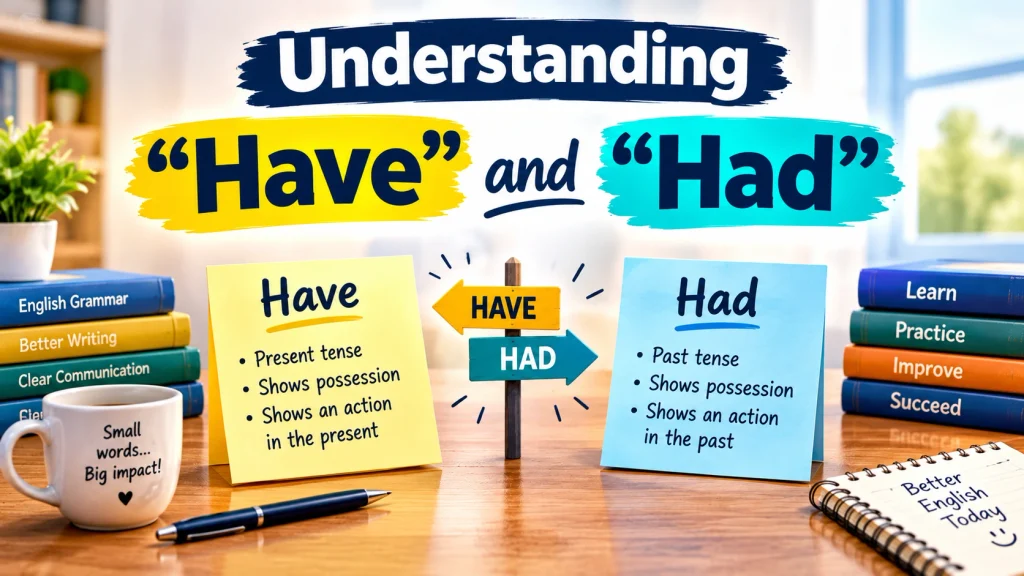
The verb have is an irregular verb with several forms.
| Form | Example |
| Base form | have |
| Third-person singular | has |
| Simple past | had |
| Past participle | had |
| -ing form | having |
Examples:
- I have a car.
- She has a car.
- They had a car.
- I have had this car for years.
- He is having lunch.
The important point is that had is the simple past form of have, but that does not mean it should be used after did.
Grammar Guide

The central grammar rule is simple:
After “did,” use the base form of the main verb.
This applies to have and to many other verbs.
| Statement | Past Question |
| You had breakfast. | Did you have breakfast? |
| She went home. | Did she go home? |
| They bought a laptop. | Did they buy a laptop? |
| He saw the movie. | Did he see the movie? |
| We finished the work. | Did we finish the work? |
This demonstrates that the rule is much broader than the difference between did you have and did you had.
How Each Term Is Used in Sentences
The basic pattern for a simple past question is:
Did + subject + base verb + rest of sentence?
For this particular verb:
Did + you + have + object?
Examples:
- Did you have breakfast?
- Did you have enough money?
- Did you have a meeting yesterday?
- Did you have any difficulty?
- Did you have a good experience?
The same structure works with different subjects:
- Did I have enough time?
- Did he have a ticket?
- Did she have lunch?
- Did we have permission?
- Did they have a problem?
Notice that have does not change to had.
Common Mistakes Learners Make
One common mistake is assuming that every past question must contain a past-tense main verb.
For example:
❌ Did you had lunch?
The learner sees a past-time meaning and chooses had. However, did already expresses the past.
Another common mistake is using had after did not:
❌ I didn’t had enough money.
Correct:
✅ I didn’t have enough money.
The same principle applies to questions and negative sentences:
- Did you have…?
- I didn’t have…
- She didn’t have…
- Did they have…?
Simple Rules to Remember
Use this one-line rule:
Did + base verb, not past verb.
So:
- Did + have ✅
- Did + had ❌
- Did + go ✅
- Did + went ❌
- Did + eat ✅
- Did + ate ❌
- Did + see ✅
- Did + saw ❌
A useful memory trick is:
“Did does the past-tense job.”
Once did appears, let the main verb stay simple.
Quick Tips for Writing and Speaking
When you are unsure whether to use have or had after did, check for the word did.
If the sentence contains:
Did + subject + ______
choose the base form:
- Did you have?
- Did you go?
- Did you eat?
- Did you see?
- Did you know?
Avoid:
- ❌ Did you had?
- ❌ Did you went?
- ❌ Did you ate?
- ❌ Did you saw?
- ❌ Did you knew?
This quick check can prevent many common English grammar errors.
“Did You Have” vs. “You Had”
Both can be correct because they serve different grammatical purposes.
“You Had”
Had is correct in a simple past statement.
Examples:
- You had breakfast.
- You had a meeting.
- You had enough money.
- You had a great time.
“Did You Have”
Did you have is correct when the same idea becomes a simple past question.
Examples:
- Did you have breakfast?
- Did you have a meeting?
- Did you have enough money?
- Did you have a great time?
The transformation looks like this:
You had lunch.
↓
Did you have lunch?
The main verb changes from had back to have because did now carries the past tense.
“Did You Have” vs. “Have You Had”
These two expressions are both grammatically correct, but they are not always used in the same circumstances.
Did You Have?
Use did you have for a simple past question, particularly when referring to a completed or specific past time.
Examples:
- Did you have breakfast this morning?
- Did you have a meeting yesterday?
- Did you have fun at the party?
- Did you have trouble finding the building?
Have You Had?
Use have you had when using the present perfect, often connecting an experience to the present.
Examples:
- Have you had breakfast yet?
- Have you had any problems today?
- Have you had a chance to read the report?
- Have you had enough rest?
The choice can depend on the time reference and variety of English. The important point is that have you had is not the same grammatical structure as did you have. (grammarprecision.com)
When to Use Each One
Use “Did You Have” When Asking About the Past
Use it when asking whether something happened or existed at a particular time in the past.
Examples:
- Did you have breakfast this morning?
- Did you have a class yesterday?
- Did you have enough time to finish?
- Did you have a good vacation?
- Did you have any problems with the software?
Use “Had” in Statements
Use had when the sentence is a simple past statement without did.
Examples:
- I had breakfast at seven.
- She had a meeting yesterday.
- We had a great experience.
- They had enough money.
- He had a red bicycle.
Use “Had” in Other Perfect Structures
Had can also work as an auxiliary verb in past perfect constructions.
For example:
- Had you finished the report before the meeting?
- Had she already left when you arrived?
- They had completed the project before Friday.
Here, had is not simply functioning as the past form of ordinary have. It is helping create the past perfect construction.
When NOT to Use Each One
Do Not Use “Did You Had”
Avoid:
❌ Did you had breakfast?
Use:
✅ Did you have breakfast?
Do Not Use “Did” With a Past-Tense Main Verb
The same error appears with many verbs:
❌ Did you went there?
✅ Did you go there?
❌ Did she saw him?
✅ Did she see him?
❌ Did they bought it?
✅ Did they buy it?
❌ Did he ate lunch?
✅ Did he eat lunch?
The pattern is always the same: did + base verb.
Do Not Use “Had” Simply Because the Question Refers to the Past
Past meaning alone does not determine the form of the main verb.
For example:
❌ Did you had a car?
The sentence refers to the past, but the correct form is:
✅ Did you have a car?
The word did already establishes the past-tense question.
When “Had” Is Correct
It is important not to conclude that had is always wrong. It is a perfectly normal English word.
Use had in statements:
- I had a dog.
- She had a headache.
- They had a meeting.
Use had in past perfect constructions:
- I had finished the work before noon.
- She had already eaten when I arrived.
- They had left before the rain started.
You can even see had in a question when the grammatical structure requires it:
Had you had breakfast before the meeting?
Here, the first had is the past-perfect auxiliary, while the second had is the past participle of have. This is completely different from the incorrect simple-past construction “Did you had?”
Which One to Use (Decision Guide)
Use this quick guide:
| If you want to… | Use |
| Ask a simple past question | Did you have…? |
| Make a simple past statement | You had… |
| Ask a present-perfect question | Have you had…? |
| Ask a past-perfect question | Had you had…? |
| Make a negative simple past statement | You didn’t have… |
| Make a simple past question | Did + subject + have…? |
Quick Decision Test
Ask yourself:
Is “did” already in the question?
If yes, use have, not had.
For example:
Did you ______ breakfast?
Answer:
have ✅
Not:
had ❌
If there is no did, and you are making a simple past statement:
You ______ breakfast at eight.
Answer:
had ✅
Real-World Practical Examples
“Did You Have” Examples
Education
Did you have an English class yesterday?
Here, did establishes the past, and have remains in its base form.
Daily Life
Did you have breakfast before leaving home?
The question asks about a completed past activity.
Science
Did you have enough samples for the experiment?
The question asks about the availability or possession of something in the past.
Business
Did you have a meeting with the client yesterday?
The question refers to a specific past business event.
Technology
Did you have any problems installing the application?
The phrase asks about an experience with technology.
Conversation
Did you have fun at the concert?
This asks about an experience.
Travel
Did you have any trouble at the airport?
The speaker asks about a past travel experience.
Writing
Did you have enough evidence to support your argument?
This asks whether sufficient evidence was available.
“Did You Had” Examples
Because “did you had” is incorrect, it should not be used as a model sentence.
Instead, replace it with “did you have.”
Education
❌ Did you had a test yesterday?
✅ Did you have a test yesterday?
Daily Life
❌ Did you had breakfast?
✅ Did you have breakfast?
Business
❌ Did you had a meeting?
✅ Did you have a meeting?
Technology
❌ Did you had internet access?
✅ Did you have internet access?
Travel
❌ Did you have a passport with you?
✅ Did you have a passport with you?
Conversation
❌ Did you have a good time?
✅ Did you have a good time?
More Examples Across Different Contexts
Education
- Did you have homework last night?
- Did you have a difficult exam?
- Did you have enough time to finish the assignment?
- Did you have a teacher who helped you?
- Did you have an English lesson today?
Daily Life
- Did you have breakfast?
- Did you have enough sleep?
- Did you have time to clean the house?
- Did you have any visitors?
- Did you have a busy weekend?
Business
- Did you have a meeting with your manager?
- Did you have enough information?
- Did you have time to review the contract?
- Did you have any concerns about the proposal?
- Did you have a chance to speak with the customer?
Science
- Did you have enough data for the study?
- Did you have a control group?
- Did you have accurate measurements?
- Did you have enough samples?
- Did you have any unexpected results?
Technology
- Did you have trouble accessing the website?
- Did you have a backup of the files?
- Did you have an internet connection?
- Did you have permission to access the system?
- Did you have problems updating the software?
Travel
- Did you have a comfortable flight?
- Did you have enough luggage space?
- Did you have trouble finding the hotel?
- Did you have travel insurance?
- Did you have enough cash?
Common Transformations
Understanding how statements change into questions is one of the easiest ways to master this rule.
| Statement | Question |
| You had breakfast. | Did you have breakfast? |
| You had a car. | Did you have a car? |
| You had enough money. | Did you have enough money? |
| She had a meeting. | Did she have a meeting? |
| They had a problem. | Did they have a problem? |
| He had a chance. | Did he have a chance? |
Notice the consistent pattern:
had → did + have
This is the core transformation to remember.
Self-Assessment (Fill in the Blanks)
Complete each sentence with the correct form.
- Did you ______ breakfast before school?
- Did she ______ enough money for the trip?
- Did they ______ a meeting yesterday?
- Did he ______ any problems with the computer?
- Did we ______ enough time to finish the project?
- You ______ a great time at the party.
- Did your teacher ______ a question for you?
- Did the company ______ enough resources?
- They ______ a house near the beach.
- Did you ______ any experience with this software?
- Did she ______ lunch before the meeting?
- We ______ a difficult exam last week.
- Did he ______ a chance to explain himself?
- Did you ______ a passport with you?
- She ______ a busy day yesterday.
- Did they ______ enough evidence?
- Did you ______ trouble finding the address?
- He ______ a bicycle when he was younger.
- Did we ______ permission to enter?
- Did the students ______ enough time to complete the test?
Answers
- have — “Did” already marks the past tense, so the base form have is required.
- have — The correct pattern is did + subject + base verb.
- have — We say “Did they have a meeting?” rather than “Did they had a meeting?”
- have — Had cannot normally follow did in a simple past question.
- have — “Did” carries the past-tense marking.
- had — This is a simple past statement without the auxiliary did.
- have — The base form follows did.
- have — “Did the company have enough resources?” is the correct structure.
- had — This is a simple past statement, so had is appropriate.
- have — Use the base form after did.
- have — “Did she have lunch?” is correct.
- had — This is a past-tense statement without did.
- have — The correct question is “Did he have a chance?”
- have — The correct pattern is “Did you have a passport?”
- had — Had is correct because this is a simple past statement.
- have — Use the base form after did.
- have — “Did you have trouble?” follows the standard rule.
- had — This is a simple past statement.
- have — The correct question is “Did we have permission?”
- have — “Did the students have enough time?” is grammatically correct.
A Simple Way to Remember the Difference
Think of did as the word responsible for showing the past tense.
When you say:
Did you have…?
the word did has already done the past-tense work.
Therefore, the main verb stays simple:
did + have
not:
did + had
You can use the same idea with other verbs:
- Did you go?
- Did you eat?
- Did you see?
- Did you write?
- Did you buy?
- Did you know?
- Did you have?
This rule is one of the most useful patterns for forming accurate English questions in the simple past.
Frequently Asked Questions About Did You Have or Did You Had
Is “Did you have” correct?
Yes. “Did you have” is the grammatically correct form for a simple past question. The word did carries the past-tense marking, so the main verb remains in its base form, have. For example, “Did you have breakfast?” is correct.
Is “Did you had” correct?
No. “Did you had” is incorrect in standard English when used as a simple past question. The correct form is “Did you have?” Since did already expresses past tense, the main verb should remain in its base form.
Why do we use “have” after “did”?
We use have because did is the past-tense auxiliary in the question. English uses the base form of the main verb after did. Therefore, the correct pattern is did + subject + base verb, such as “Did you have lunch?”
Is “had” the past tense of “have”?
Yes. Had is the simple past form of have. For example, “I had breakfast at eight.” However, when you create a simple past question with did, the verb returns to its base form: “Did you have breakfast?”
Can “had” ever be used in a question?
Yes. Had can correctly appear in questions when it serves another grammatical function, particularly in past perfect constructions. For example, “Had you finished the report before the meeting?” The structure is different from the incorrect “Did you had?”
What is the rule after “did”?
The basic rule is: after did, use the base form of the verb. Examples include “Did you go?”, “Did she eat?”, “Did they see?”, and “Did he have?” Do not normally use past forms such as went, ate, saw, or had immediately after did.
What is the difference between “Did you have?” and “Have you had?”
“Did you have?” is a simple past question, often referring to a completed past event or a particular past time. “Have you had?” uses the present perfect and often connects an experience with the present. For example, “Did you have lunch at noon?” differs from “Have you had lunch yet?”
Is “I didn’t have” correct?
Yes. “I didn’t have” is correct. The same rule applies to negative sentences. Because didn’t already contains the past-tense form of do, the main verb remains in its base form: “I didn’t have enough time.”
Can I say “Did you had breakfast?”
No. In standard English, say “Did you have breakfast?” The incorrect version uses both did and had as past-tense forms in the same simple past question structure. The correct construction is did + subject + have.
What is the easiest way to remember “Did you have”?
Remember this simple formula: Did + subject + base verb. Since have is the base form and had is the past form, the correct choice is “Did you have?” Whenever you see did, check that the next main verb is in its base form.
Final Verdict
The correct phrase is “Did you have?”, while “Did you had?” is grammatically incorrect in standard English.
The reason is straightforward: did already carries the past tense in a simple past question, so the main verb must remain in its base form.
Correct:
- Did you have breakfast?
- Did you have enough time?
- Did you have a meeting?
- Did you have any problems?
- Did you have fun?
Incorrect:
- Did you have breakfast?
- Did you have enough time?
- Did you have a meeting?
- Did you have any problems?
- Did you have fun?
The most useful rule to remember is:
Did + subject + base verb
Once you understand this pattern, you can apply it to many other verbs, not just have. So whenever you are choosing between “did you have” and “did you had,” choose “did you have.” It is the clear, correct, and standard form for a simple past question. (Correct Wording)
Conclusion :
Understanding the difference between “did you have” and “did you had” becomes easy once you remember one essential grammar rule: after “did,” use the base form of the verb. That is why “Did you have?” is correct, while “Did you had?” is incorrect in standard English. The word “did” already carries the past tense, so “have” should remain unchanged. On the other hand, “had” is correct when used without “did,” such as in “You had breakfast.” Learning this simple pattern can help you avoid a common English grammar mistake in conversations, schoolwork, professional writing, and everyday communication. Whenever you see “did” before the verb, think base form. So, when choosing between “Did You Have” and “r Did You Had,” confidently choose “Did You Have” for a simple past question.
FAQs About Did You Have or Did You Had
Is “Did you have” grammatically correct?
Yes, “Did you have” is grammatically correct in standard English. It follows the simple past question structure, where “did” carries the past tense and “have” remains in its base form. For example, “Did you have breakfast?” and “Did you have enough time?” are both correct and natural questions.
Is “Did you had” grammatically correct?
No, “Did you had” is not correct in a standard simple past question. The problem is that “did” already marks the sentence as past tense. Therefore, the main verb must stay in its base form. The correct expression is “Did you have?”, not “Did you had?”
Why do we say “Did you have” instead of “Did you had”?
We say “Did you have” because English uses the base form of the main verb after the auxiliary “did.” Although “had” is the past form of “have,” the past tense is already expressed by “did.” Therefore, the correct structure is did + subject + have.
What is the difference between “have” and “had”?
“Have” is the base form of the verb, while “had” is its simple past form and past participle. For example, “I have a car” describes the present, while “I had a car” describes the past. In questions with “did,” use “have”: “Did you have a car?”
Can “had” be used after “did” in any sentence?
In ordinary simple past questions, “had” should not follow “did.” However, “had” can appear elsewhere in a sentence with “did” when it belongs to a different grammatical structure. For example, “Did you realize that she had already left?” is correct because “had” belongs to the past perfect clause.
Is “Did you have breakfast?” correct?
Yes, “Did you have breakfast?” is completely correct. It asks whether someone ate breakfast at a past time. The structure follows the rule did + subject + base verb, so “have” is required. Saying “Did you had breakfast?” would be incorrect in standard English.
Is “Did you have” past tense?
Yes. “Did you have” forms a simple past question. The word “did” is the past-tense auxiliary, while “have” remains in its base form. For example, “Did you have a meeting yesterday?” asks about an event that occurred in the past.
What should come after “did” in English?
A base-form verb normally comes after “did.” Examples include “Did you go?” “Did she eat?” “Did they see?” and “Did he have?” Avoid using past-tense forms such as “went,” “ate,” “saw,” or “had” directly after “did” in simple past questions.
Is “Did you had a good time?” correct?
No, the correct sentence is “Did you have a good time?” The word “did” already establishes the past tense, so “have” must remain in its base form. This same rule applies whether you are asking about experiences, possessions, activities, events, or situations in the past.
How can I easily remember “Did you have” versus “Did you had”?
Remember this simple formula: did + subject + base verb. Since “have” is the base form and “had” is the past form, choose “have” after “did.” A quick reminder is: “Did does the past-tense work.” This rule helps you form many correct English questions, not just questions using “have.”
Meta Description
Did You Have or Did You Had explained clearly: learn which phrase is correct, why “did you have” works, and how to use it naturally.