
Problems are a natural part of life, but finding the right words to describe them can make your writing more vivid and memorable. Similes for Problems help readers picture difficulties through familiar comparisons, making abstract challenges easier to understand. Whether you are writing an essay, story, speech, poem, or social media post, these creative similes can add emotion, clarity, and personality to your words.
Definition of Similes for Problems
Similes for Problems are comparisons that describe difficulties, challenges, troubles, or complicated situations by connecting them to something familiar. They usually use words such as “like” or “as.”
For example, saying “The problem was like a tangled knot” creates a clearer picture than simply saying “The problem was difficult.” A strong simile can show how confusing, stressful, overwhelming, frustrating, or even manageable a problem feels.
What Is a Simile?
A simile is a figure of speech that compares two different things using words such as “like” or “as.” Writers use similes to create strong mental pictures and communicate feelings more effectively.
Example
- The problem was like a maze with no exit.
- Her worries spread like dark clouds across the sky.
- The difficult decision felt as heavy as a stone.
- His workload was like a mountain standing in his path.
- The argument grew like a small fire becoming a wildfire.
Why Use Similes for Problems in Writing?
- Make problems easier to visualize: A comparison gives readers a mental picture of an otherwise abstract difficulty.
- Create emotional impact: A powerful simile can communicate fear, stress, frustration, or hope.
- Make writing memorable: Creative comparisons often stay in a reader’s mind longer than plain descriptions.
- Add personality: Similes can make ordinary explanations sound more expressive.
- Improve storytelling: They help readers experience a character’s struggle instead of simply being told about it.
- Explain difficult ideas: A familiar comparison can make complicated situations easier to understand.
- Show intensity: Similes can reveal whether a problem feels small, serious, confusing, or overwhelming.
Types of Similes
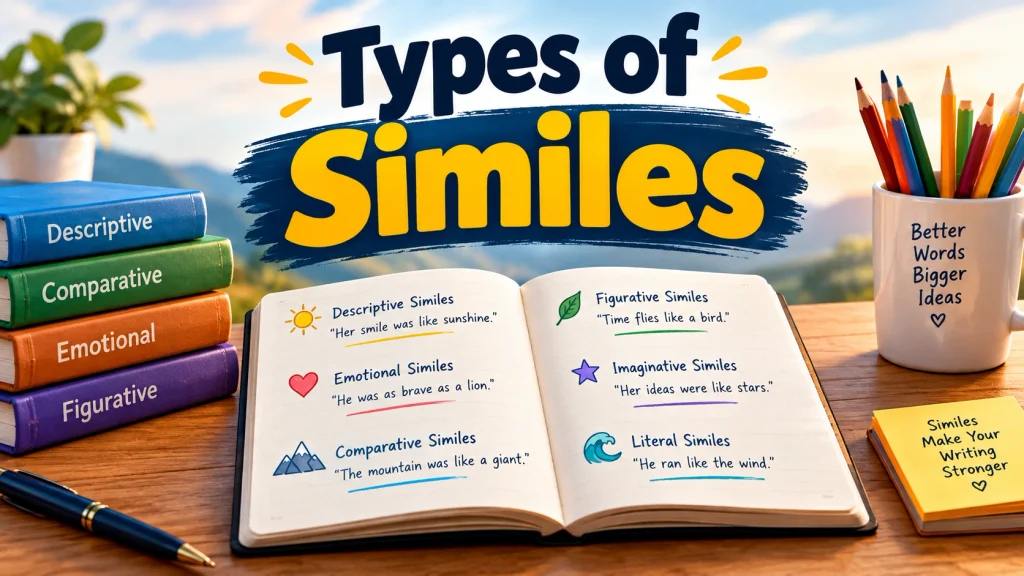
Similes for Problems can take many forms. Some focus on emotional struggles, while others compare challenges with physical obstacles, nature, objects, or everyday experiences. Choosing the right type depends on the feeling and message you want to communicate.
Descriptive Similes
Descriptive similes create a clear picture of what a problem looks or feels like. They work especially well in essays, stories, and creative writing.
Example
- The problem was like a locked door without a key.
- The situation was as confusing as a map with missing roads.
- His challenge stood like a wall between him and his goal.
Emotional Similes
Emotional similes focus on the feelings that problems create. They can describe worry, fear, sadness, frustration, pressure, or uncertainty.
Example
- Her anxiety felt like a storm trapped inside her chest.
- The disappointment was as heavy as a rain-filled cloud.
- His fear clung to him like a shadow at sunset.
Nature-Based Similes
Nature provides powerful images for describing challenges. Storms, mountains, rivers, fires, and clouds can represent different kinds of struggles.
Example
- The problem arrived like a sudden thunderstorm.
- Their challenge rose as high as a mountain.
- Confusion spread like fog across a quiet valley.
Object-Based Similes
These similes compare problems with familiar objects. They are useful when you want your writing to feel simple and relatable.
Example
- The issue was like a tangled ball of string.
- The disagreement became as sharp as a broken piece of glass.
- The decision felt like carrying a suitcase full of stones.
Writing Tips and Common Mistakes
Useful Tips
- Choose a comparison that clearly matches the problem.
- Use familiar images that most readers can understand.
- Match the simile’s tone to your subject.
- Avoid comparisons that distract from your main idea.
- Use strong nouns and verbs around your simile.
- Keep the comparison natural instead of forcing it.
- Choose dramatic imagery only when the situation deserves it.
- Use fresh comparisons instead of repeating common clichés.
- Read the sentence aloud to check whether the simile sounds natural.
- Make sure the comparison adds meaning rather than simply adding decoration.
Common Mistakes to Avoid
- Using an unclear comparison: “The problem was like something strange” gives readers no useful image.
- Mixing metaphors and similes: Avoid combining unrelated comparisons in one sentence.
- Overusing similes: Too many comparisons can make writing feel crowded.
- Choosing an exaggerated image: A small inconvenience probably does not need to become “a hurricane destroying the world.”
- Using clichés too often: Expressions such as “a mountain of problems” can become predictable when repeated.
- Forgetting the comparison word: A traditional simile usually uses words such as “like” or “as.”
- Using an unsuitable tone: A humorous simile may not fit a serious or tragic situation.
- Making the sentence too complicated: A simple comparison often creates the strongest image.
50 Similes for Problems

A Problem Like a Locked Door
Meaning: A problem that prevents progress until you find the right solution.
Detailed Explanation: This simile presents a difficulty as a barrier. It suggests that the answer may exist, but you need the right approach, knowledge, or opportunity to move forward.
Tone: Determined, hopeful, challenging.
Examples:
- The difficult assignment was like a locked door waiting for the right key.
- Her financial problem seemed like a locked door blocking her next step.
- The mystery was like a locked door that refused to reveal its secret.
A Problem Like a Tangled Knot
Meaning: A confusing problem with many connected parts.
Detailed Explanation: A tangled knot represents a situation that becomes difficult because everything seems connected. Solving one part may require patience before the entire problem becomes clear.
Tone: Confusing, thoughtful, patient.
Examples:
- The family disagreement was like a tangled knot of old misunderstandings.
- The project became like a tangled knot of deadlines and mistakes.
- His thoughts were like a tangled knot he could not loosen.
A Problem Like a Mountain
Meaning: A large or intimidating challenge.
Detailed Explanation: A mountain represents something that requires effort, endurance, and determination. This comparison works well when a problem initially appears almost impossible.
Tone: Dramatic, determined, motivational.
Examples:
- The final exam looked like a mountain standing before him.
- Their debt seemed like a mountain that would take years to climb.
- The challenge rose like a mountain above their confidence.
A Problem Like a Maze
Meaning: A confusing situation with many possible directions.
Detailed Explanation: A maze represents uncertainty. You may have several choices, but you cannot immediately see which path leads to the solution.
Tone: Mysterious, confusing, thoughtful.
Examples:
- The legal situation felt like a maze without a clear exit.
- Finding the right answer was like walking through a maze in the dark.
- His thoughts became like a maze filled with dead ends.
A Problem Like a Storm
Meaning: A problem that arrives suddenly and creates emotional or practical turmoil.
Detailed Explanation: Storms bring wind, rain, noise, and uncertainty. This makes them useful for describing difficult situations that disrupt peace and demand immediate attention.
Tone: Dramatic, intense, emotional.
Examples:
- The unexpected news hit like a storm on a peaceful morning.
- Their disagreement grew like a storm over the horizon.
- The crisis swept through the company like a sudden storm.
A Problem Like a Heavy Backpack
Meaning: A problem that becomes emotionally or mentally exhausting.
Detailed Explanation: A heavy backpack becomes harder to carry the longer you walk. This comparison captures how unresolved problems can gradually drain a person’s energy.
Tone: Relatable, emotional, serious.
Examples:
- His responsibilities felt like a heavy backpack on a long journey.
- The secret became like a heavy backpack he carried everywhere.
- Her worries were like a backpack filled with invisible stones.
A Problem Like a Thorn
Meaning: A small but painful problem that keeps causing discomfort.
Detailed Explanation: A thorn may be tiny, but it can cause significant pain. This simile works well for persistent annoyances or minor issues that refuse to disappear.
Tone: Sharp, uncomfortable, realistic.
Examples:
- The unresolved argument remained like a thorn in their friendship.
- That small mistake became like a thorn in his memory.
- The unpaid bill felt like a thorn that would not stop hurting.
A Problem Like a Broken Compass
Meaning: A situation in which you do not know which direction to take.
Detailed Explanation: A compass normally provides direction. A broken one leaves you uncertain, making this simile useful for describing confusion and difficult decisions.
Tone: Uncertain, reflective, serious.
Examples:
- After losing his job, he felt like a traveler holding a broken compass.
- The confusing instructions left us like hikers with a broken compass.
- Her choices seemed like roads viewed through a broken compass.
A Problem Like a Shadow
Meaning: A problem that follows someone wherever they go.
Detailed Explanation: A shadow stays close to its source. This makes it a strong comparison for worries or difficulties that remain present even when someone tries to ignore them.
Tone: Dark, emotional, reflective.
Examples:
- His mistake followed him like a shadow.
- The debt remained like a shadow over the family.
- Doubt followed her like a shadow on a sunny day.
A Problem Like a Leaking Roof
Meaning: A problem that keeps causing trouble until someone repairs its source.
Detailed Explanation: A leaking roof may seem manageable at first, but continued water can create bigger damage. The simile highlights the importance of solving problems early.
Tone: Practical, realistic, cautionary.
Examples:
- Ignoring the small disagreement was like ignoring a leaking roof.
- Their communication problem became like a leaking roof during a storm.
- The minor software bug was like a leaking roof slowly damaging the house.
A Problem Like a Burning Fuse
Meaning: A problem that could quickly become more serious.
Detailed Explanation: A burning fuse suggests limited time. It works well when a problem requires immediate attention before it creates greater consequences.
Tone: Urgent, tense, dramatic.
Examples:
- The growing conflict was like a burning fuse.
- Ignoring the warning signs was like watching a burning fuse.
- The unresolved issue sat like a burning fuse beneath the team.
A Problem Like a Wall
Meaning: A problem that blocks progress.
Detailed Explanation: A wall physically prevents movement from one side to another. This comparison makes it useful for describing obstacles that stand between people and their goals.
Tone: Strong, determined, challenging.
Examples:
- Fear stood like a wall between her and success.
- The technical issue became like a wall blocking the entire project.
- Their disagreement stood like a wall between old friends.
A Problem Like a Puzzle
Meaning: A difficult situation that requires careful thought to solve.
Detailed Explanation: A puzzle contains separate pieces that must fit together. This simile suggests that patience, observation, and reasoning can reveal the answer.
Tone: Curious, thoughtful, intellectual.
Examples:
- The mystery was like a puzzle missing its final piece.
- The business problem felt like a puzzle spread across a giant table.
- Solving the disagreement was like fitting the last piece into a puzzle.
A Problem Like Quicksand
Meaning: A situation that becomes worse when handled carelessly.
Detailed Explanation: Quicksand creates the feeling of being trapped and unable to escape easily. This simile suits problems that become more difficult when someone reacts without thinking.
Tone: Tense, dangerous, dramatic.
Examples:
- The argument became like quicksand beneath their feet.
- His debt felt like quicksand pulling him deeper.
- Every careless decision made the situation like quicksand.
A Problem Like Fog
Meaning: A problem that makes the correct path difficult to see.
Detailed Explanation: Fog reduces visibility. It provides a natural comparison for uncertainty, confusion, and situations where the solution remains unclear.
Tone: Mysterious, uncertain, reflective.
Examples:
- Confusion surrounded the decision like fog over a quiet road.
- The future looked like a road hidden by fog.
- The complicated instructions were like fog covering the answer.
A Problem Like a Traffic Jam
Meaning: A situation in which progress becomes slow or impossible.
Detailed Explanation: Traffic jams stop vehicles from moving freely. This simile works especially well for describing delays, workplace bottlenecks, or crowded decision-making.
Tone: Frustrating, practical, relatable.
Examples:
- The approval process was like a traffic jam during rush hour.
- Too many opinions created a traffic jam of ideas.
- The project moved like a car trapped in a traffic jam.
A Problem Like a Puzzle With Missing Pieces
Meaning: A problem that cannot be solved because important information is missing.
Detailed Explanation: A puzzle becomes difficult when pieces are missing. This simile highlights situations where people need more facts before they can make a good decision.
Tone: Mysterious, thoughtful, uncertain.
Examples:
- The investigation was like a puzzle with several missing pieces.
- His explanation felt like a puzzle missing its center.
- The incomplete report was like a puzzle with half the pieces gone.
A Problem Like a Chain
Meaning: A difficulty caused by several connected events.
Detailed Explanation: Each link in a chain connects to another. This simile shows how one mistake or challenge can lead to another.
Tone: Serious, connected, analytical.
Examples:
- One missed deadline became like a chain of problems.
- The mistakes formed like links in a chain.
- His poor decision started a chain of unexpected difficulties.
A Problem Like a Crack in Glass
Meaning: A small issue that can spread if ignored.
Detailed Explanation: A tiny crack in glass can grow across the surface. This comparison reminds readers that even small problems deserve attention before they expand.
Tone: Cautionary, delicate, serious.
Examples:
- Their small disagreement was like a crack in glass.
- The minor error became like a crack spreading across a window.
- Trust broke like glass under sudden pressure.
A Problem Like a Snowball
Meaning: A small problem that grows larger over time.
Detailed Explanation: A snowball can become larger as it rolls. This simile describes problems that increase because people ignore them or allow additional difficulties to accumulate.
Tone: Cautionary, relatable, progressive.
Examples:
- The missed payment became like a snowball rolling downhill.
- One small misunderstanding grew like a snowball.
- Their unfinished tasks piled up like a snowball gathering snow.
A Problem Like a Puzzle Box
Meaning: A difficult problem that hides its solution.
Detailed Explanation: A puzzle box often requires patience and clever thinking before it opens. This comparison suits complicated problems with unexpected solutions.
Tone: Mysterious, clever, curious.
Examples:
- The strange situation was like a puzzle box with a secret opening.
- The mystery seemed like a puzzle box waiting for patience.
- The difficult question was like a puzzle box with hidden clues.
A Problem Like a Broken Bridge
Meaning: A problem that prevents connection or progress.
Detailed Explanation: A bridge connects two places. A broken bridge stops people from reaching the other side, making it a strong image for communication problems and blocked opportunities.
Tone: Emotional, serious, symbolic.
Examples:
- Their silence became like a broken bridge between them.
- The disagreement was like a broken bridge between two teams.
- Poor communication left us like travelers facing a broken bridge.
A Problem Like a Storm Cloud
Meaning: A troubling situation that creates a feeling of approaching danger or sadness.
Detailed Explanation: A storm cloud often signals unpleasant weather. It can therefore represent worry or trouble that hangs over a person or situation.
Tone: Dark, emotional, anticipatory.
Examples:
- The unpaid bills hung like a storm cloud over the family.
- His worry followed him like a storm cloud.
- The bad news appeared like a storm cloud on the horizon.
A Problem Like a Door With No Handle
Meaning: A problem that seems impossible to enter, understand, or solve.
Detailed Explanation: A door without a handle prevents normal access. The image suggests frustration when a person can see a possible solution but cannot find a way to reach it.
Tone: Frustrating, mysterious, challenging.
Examples:
- The complicated instructions were like a door with no handle.
- The mystery felt like a door with no visible way inside.
- The situation became like a door without a handle.
A Problem Like a Rope Pulling Tight
Meaning: A situation involving increasing pressure or tension.
Detailed Explanation: A rope becomes tighter when people pull from opposite directions. This simile works well for conflicts, deadlines, and stressful decisions.
Tone: Tense, dramatic, serious.
Examples:
- The disagreement felt like a rope pulling tighter.
- The deadline was like a rope stretched to its limit.
- Pressure grew like a rope tightening around the situation.
A Problem Like a Puzzle in the Dark
Meaning: A challenge that must be solved without enough information.
Detailed Explanation: A puzzle is already challenging, but darkness makes it even harder. This comparison emphasizes uncertainty and limited understanding.
Tone: Mysterious, difficult, uncertain.
Examples:
- The case felt like a puzzle in the dark.
- Finding the answer was like solving a puzzle without seeing the pieces.
- Their future seemed like a puzzle hidden in darkness.
A Problem Like a Weight on Your Shoulders
Meaning: A problem that creates emotional or mental pressure.
Detailed Explanation: Carrying weight becomes tiring. This simile captures the exhaustion caused by responsibility, worry, guilt, or unresolved difficulties.
Tone: Emotional, serious, relatable.
Examples:
- The secret felt like a weight on his shoulders.
- Her responsibilities rested like heavy weights on her shoulders.
- The unresolved problem became like a weight she carried every day.
A Problem Like a River Blocking the Road
Meaning: A challenge that unexpectedly prevents progress.
Detailed Explanation: A river can force travelers to stop or find another route. This simile works well when a person must change plans because of an unexpected obstacle.
Tone: Adventurous, challenging, hopeful.
Examples:
- The sudden expense was like a river blocking the road.
- The technical failure became like a river cutting across our plans.
- Their disagreement stood like a river between two solutions.
A Problem Like a Broken Clock
Meaning: A situation that repeatedly creates confusion or gives unreliable results.
Detailed Explanation: A broken clock cannot reliably tell the correct time. This simile can describe systems, plans, or information that people cannot trust.
Tone: Frustrating, uncertain, critical.
Examples:
- The unreliable schedule was like a broken clock.
- His changing promises were like a broken clock showing random times.
- The outdated system worked like a broken clock.
A Problem Like a Thorny Path
Meaning: A difficult journey filled with obstacles.
Detailed Explanation: A thorny path makes movement painful and difficult. It represents situations where reaching a goal requires patience and persistence.
Tone: Poetic, challenging, hopeful.
Examples:
- Building the business was like walking along a thorny path.
- Recovery from the mistake felt like a thorny path.
- Their journey toward success was like a path covered with thorns.
A Problem Like a Puzzle With Moving Pieces
Meaning: A problem that constantly changes as you try to solve it.
Detailed Explanation: Some challenges change whenever new information appears. This simile captures situations where the solution cannot remain fixed.
Tone: Complex, thoughtful, challenging.
Examples:
- The negotiation was like a puzzle with moving pieces.
- Managing the project felt like solving a puzzle that changed every hour.
- The crisis was like a puzzle whose pieces refused to stay still.
A Problem Like an Unfinished Road
Meaning: A challenge that prevents someone from reaching a destination.
Detailed Explanation: An unfinished road suggests that progress has started but cannot continue normally. It works well for incomplete plans and interrupted goals.
Tone: Reflective, hopeful, uncertain.
Examples:
- His career felt like an unfinished road.
- The abandoned project was like an unfinished road leading nowhere.
- Their plan remained like a road waiting for its final stretch.
A Problem Like a Rusty Lock
Meaning: A long-standing difficulty that has become harder to solve with time.
Detailed Explanation: Rust makes a lock harder to open. This image suggests that neglect can make old problems more difficult to resolve.
Tone: Serious, symbolic, cautionary.
Examples:
- Their old disagreement was like a rusty lock.
- Years of silence became like rust around the problem.
- The neglected issue was like a rusty lock needing patience.
A Problem Like a Puzzle Missing Its Center
Meaning: A problem that seems complete but lacks an essential part.
Detailed Explanation: A puzzle can have many pieces in place but remain unfinished without its center. This simile emphasizes the importance of one missing fact or decision.
Tone: Thoughtful, mysterious, incomplete.
Examples:
- The report was like a puzzle missing its center.
- Their plan seemed like a puzzle with its most important piece missing.
- The explanation was like a picture without its center.
A Problem Like a Candle in the Wind
Meaning: A fragile situation that could easily become worse.
Detailed Explanation: A candle exposed to wind can flicker or go out. This simile suits situations that require careful attention and protection.
Tone: Poetic, fragile, emotional.
Examples:
- Their fragile agreement was like a candle in the wind.
- His confidence felt like a candle struggling against the wind.
- Their hope remained like a candle in a restless storm.
A Problem Like a Door That Keeps Moving
Meaning: A problem whose solution changes whenever you approach it.
Detailed Explanation: A moving door makes it difficult to enter. The image represents situations where changing conditions make a stable solution difficult to find.
Tone: Frustrating, playful, challenging.
Examples:
- The negotiations felt like chasing a door that kept moving.
- Finding the answer was like trying to open a moving door.
- Their plans changed like a door shifting away from their hands.
A Problem Like a Knot in a Garden Hose
Meaning: A blockage that prevents normal progress.
Detailed Explanation: A knot in a hose stops water from flowing properly. This simile works for problems that interrupt communication, productivity, or progress.
Tone: Practical, relatable, mildly humorous.
Examples:
- The paperwork became like a knot in a garden hose.
- Poor communication was like a knot blocking the flow of ideas.
- The technical issue acted like a knot in the project’s progress.
A Problem Like Sand in a Machine
Meaning: A small issue that interferes with a larger system.
Detailed Explanation: Sand can prevent machinery from operating smoothly. This simile shows how seemingly minor problems can disrupt an entire process.
Tone: Practical, technical, cautionary.
Examples:
- The small error was like sand inside a machine.
- Poor communication became like sand grinding against the team’s progress.
- One missing file was like sand stopping a machine from working.
A Problem Like a Backpack Filled With Bricks
Meaning: An extremely heavy burden.
Detailed Explanation: Bricks create a strong image of weight. This simile emphasizes how exhausting a collection of responsibilities or worries can become.
Tone: Dramatic, emotional, serious.
Examples:
- His responsibilities felt like a backpack filled with bricks.
- The unresolved issues became like bricks packed into her backpack.
- Guilt followed him like a backpack full of stones.
A Problem Like a Clock Without Hands
Meaning: A situation without clear direction or useful information.
Detailed Explanation: A clock without hands cannot show the time. The comparison represents situations where people have a system or goal but lack the information needed to move forward.
Tone: Mysterious, uncertain, reflective.
Examples:
- The plan felt like a clock without hands.
- Their schedule was like a clock unable to show the time.
- The confusing instructions left us like travelers with a clock without hands.
A Problem Like a Storm Inside a Teacup
Meaning: A problem that creates a lot of emotion despite being relatively small.
Detailed Explanation: This comparison highlights situations where reactions become much larger than the actual issue. It works particularly well in humorous or light writing.
Tone: Humorous, light, playful.
Examples:
- Their disagreement was like a storm inside a teacup.
- The office argument became like a storm in a tiny cup.
- The minor mistake caused a storm inside their quiet meeting.
A Problem Like a Puzzle With Too Many Answers
Meaning: A situation where several possible solutions create confusion.
Detailed Explanation: Having many options can sometimes make a decision harder rather than easier. This simile describes uncertainty caused by competing possibilities.
Tone: Thoughtful, confusing, analytical.
Examples:
- Choosing a career felt like solving a puzzle with too many answers.
- The business decision was like a puzzle offering several possible endings.
- Their choices became like puzzle pieces that could fit in many places.
A Problem Like a Hill in Heavy Rain
Meaning: A difficult challenge made harder by unfavorable conditions.
Detailed Explanation: Climbing a hill already requires effort, while heavy rain makes the journey more difficult. This simile describes challenges complicated by additional obstacles.
Tone: Dramatic, determined, difficult.
Examples:
- Finishing the project felt like climbing a hill in heavy rain.
- Recovering from the mistake was like walking uphill through rain.
- The difficult journey became like a steep hill under dark clouds.
A Problem Like a Doorway Filled With Boxes
Meaning: A problem caused by obstacles blocking an otherwise available opportunity.
Detailed Explanation: A doorway provides access, but boxes can prevent someone from passing through. This simile suggests that the path exists but requires obstacles to be removed.
Tone: Practical, hopeful, challenging.
Examples:
- The opportunity was like a doorway blocked by boxes.
- Fear stood like boxes piled across the doorway to success.
- Their old habits were like boxes blocking a new beginning.
A Problem Like a Boat With a Hole
Meaning: A problem that continues to cause damage unless its source is fixed.
Detailed Explanation: Removing water without repairing the hole only provides temporary relief. This simile emphasizes solving the root cause rather than treating symptoms.
Tone: Practical, urgent, cautionary.
Examples:
- Fixing small symptoms without solving the cause was like emptying a boat with a hole.
- Their budget problem was like a boat slowly filling with water.
- Ignoring the debt was like sailing with a hole beneath the deck.
A Problem Like a Puzzle Underwater
Meaning: An already difficult challenge made harder by confusing conditions.
Detailed Explanation: Solving a puzzle underwater would be far more difficult than solving it normally. This image represents problems complicated by pressure, uncertainty, or limited resources.
Tone: Dramatic, imaginative, challenging.
Examples:
- The emergency felt like solving a puzzle underwater.
- Working without information was like assembling a puzzle beneath waves.
- The difficult decision became like solving a puzzle while the room flooded.
A Problem Like a Locked Chest
Meaning: A difficult problem that contains a hidden solution.
Detailed Explanation: A locked chest suggests that something valuable or important lies inside, but access requires the correct key or method.
Tone: Mysterious, adventurous, hopeful.
Examples:
- The mystery was like a locked chest hiding an important secret.
- The problem felt like a chest waiting for the right key.
- Every clue brought them closer to the locked chest of answers.
A Problem Like a Puzzle in a Hurricane
Meaning: An extremely difficult problem made worse by chaos.
Detailed Explanation: A puzzle requires concentration, while a hurricane creates disorder. Together, they represent situations where people must find solutions under intense pressure.
Tone: Dramatic, intense, chaotic.
Examples:
- Managing the crisis felt like solving a puzzle in a hurricane.
- The emergency was like trying to read instructions during a hurricane.
- Finding the solution became like assembling pieces while the world shook around them.
A Problem Like a Door Hidden in a Forest
Meaning: A solution exists but is difficult to discover.
Detailed Explanation: A hidden door suggests that an answer may be nearby without being obvious. This simile encourages curiosity and careful observation.
Tone: Mysterious, hopeful, adventurous.
Examples:
- The solution was like a door hidden deep inside a forest.
- The answer seemed like a secret doorway among the trees.
- Finding the right strategy was like discovering a hidden door in the woods.
A Problem Like a Rope Bridge
Meaning: A risky situation that requires balance and courage.
Detailed Explanation: Crossing a rope bridge requires careful movement. This comparison suits situations where one mistake could cause trouble, but progress remains possible.
Tone: Adventurous, tense, courageous.
Examples:
- The negotiation was like crossing a rope bridge.
- Starting the new business felt like stepping onto a rope bridge.
- Their uncertain plan was like a bridge swaying above a deep valley.
A Problem Like a Clock Running Backward
Meaning: A situation in which progress seems to reverse.
Detailed Explanation: A clock normally moves forward, so one moving backward creates a strong image of lost progress or repeated setbacks.
Tone: Frustrating, dramatic, reflective.
Examples:
- Every new mistake made progress feel like a clock running backward.
- The project seemed like a clock moving in reverse.
- Their efforts felt like walking forward while time moved backward.
A Problem Like a Cloud With No Silver Lining
Meaning: A difficulty that feels completely negative or hopeless.
Detailed Explanation: This simile uses the familiar image of a cloud to emphasize a situation in which a person struggles to find any positive outcome.
Tone: Sad, serious, pessimistic.
Examples:
- The setback felt like a cloud with no silver lining.
- The difficult season seemed like a sky filled with endless dark clouds.
- His disappointment hung over him like a cloud refusing to brighten.
A Problem Like a Bridge Missing One Plank
Meaning: A nearly complete solution that still has one important weakness.
Detailed Explanation: A bridge can look usable but remain dangerous when one plank is missing. This comparison highlights a small gap that prevents a plan from becoming successful.
Tone: Cautionary, practical, thoughtful.
Examples:
- The plan was like a bridge missing one important plank.
- Their solution seemed complete but remained like a bridge with one gap.
- The project was like a bridge waiting for its final piece.
A Problem Like a Door With a Thousand Keys
Meaning: A problem with many possible solutions, making the correct one difficult to identify.
Detailed Explanation: Too many keys can create confusion because you do not know which one opens the door. This simile describes situations where an abundance of choices becomes its own challenge.
Tone: Thoughtful, confusing, creative.
Examples:
- Choosing the right strategy felt like opening a door with a thousand keys.
- The decision was like searching through hundreds of keys.
- Every solution looked like another key without a label.
A Problem Like a River of Questions
Meaning: A situation that creates a continuous flow of uncertainty.
Detailed Explanation: A river keeps moving, making it a useful image for questions that seem endless. This simile works well for complicated decisions and mysteries.
Tone: Reflective, mysterious, intellectual.
Examples:
- The investigation became like a river of unanswered questions.
- Her mind filled like a river after heavy rain.
- The difficult decision created a river of questions with no clear shore.
A Problem Like a Candle Without a Flame
Meaning: A situation lacking the energy, direction, or hope needed to move forward.
Detailed Explanation: A candle without a flame cannot provide light. This comparison represents plans, relationships, or efforts that have lost their driving force.
Tone: Poetic, emotional, reflective.
Examples:
- The abandoned project felt like a candle without a flame.
- His motivation became like a candle waiting for a spark.
- Their plan stood like a candle unable to provide light.
A Problem Like a Door Slowly Closing
Meaning: A challenge involving a shrinking opportunity.
Detailed Explanation: A slowly closing door suggests that time is running out. This simile works especially well for deadlines, missed opportunities, and urgent decisions.
Tone: Urgent, dramatic, tense.
Examples:
- The deadline felt like a door slowly closing.
- Every delay was like another inch of the door shutting.
- The opportunity disappeared like a door closing before they reached it.
A Problem Like a Puzzle Made of Smoke
Meaning: A problem that seems impossible to grasp or understand.
Detailed Explanation: Smoke changes shape and cannot easily be held. This comparison describes confusing information, uncertain situations, or solutions that seem to disappear whenever you approach them.
Tone: Mysterious, poetic, frustrating.
Examples:
- The explanation was like a puzzle made of smoke.
- The truth seemed like smoke slipping through his fingers.
- Their plans became like shapes disappearing into smoke.
A Problem Like a Wall of Ice
Meaning: A cold, difficult barrier that prevents communication or progress.
Detailed Explanation: Ice suggests hardness, distance, and emotional coldness. This simile works especially well for strained relationships or emotionally difficult situations.
Tone: Cold, emotional, serious.
Examples:
- Their silence became like a wall of ice.
- Distrust stood like a frozen barrier between them.
- The disagreement created a wall of ice around their friendship.
A Problem Like a Puzzle With No Picture
Meaning: A challenge that lacks guidance or a clear idea of the desired outcome.
Detailed Explanation: A puzzle picture normally shows what the finished result should look like. Without it, solving the puzzle becomes much harder, making this a useful comparison for unclear goals.
Tone: Confusing, thoughtful, challenging.
Examples:
- The assignment felt like a puzzle with no picture on the box.
- Their project was like assembling pieces without knowing the final image.
- The unclear instructions left us like puzzle solvers without a picture.
A Problem Like a Storm Trapped in a Bottle
Meaning: A powerful problem or emotion contained beneath a calm surface.
Detailed Explanation: A storm suggests energy and chaos, while a bottle suggests confinement. Together, they create an image of pressure that could eventually break free.
Tone: Dramatic, emotional, intense.
Examples:
- His frustration was like a storm trapped inside a bottle.
- The team conflict felt like a storm waiting behind glass.
- Her anger remained like thunder trapped beneath a calm sky.
A Problem Like a Shadow on a Sunny Road
Meaning: A difficulty that remains even during otherwise positive circumstances.
Detailed Explanation: A sunny road suggests happiness or progress, while a shadow introduces an unwanted concern. This simile shows how one problem can remain present despite good circumstances.
Tone: Reflective, emotional, balanced.
Examples:
- The old mistake remained like a shadow on a sunny road.
- Her worry followed the celebration like a small shadow.
- The unresolved issue stayed like darkness beneath bright sunlight.
Top 10 Similes for Problems
| Simile | Meaning | Tone |
| A problem like a tangled knot | A confusing difficulty with connected parts | Confusing, thoughtful |
| A problem like a mountain | A large and intimidating challenge | Dramatic, determined |
| A problem like a maze | A confusing situation with no obvious direction | Mysterious, uncertain |
| A problem like a storm | A sudden and disruptive difficulty | Dramatic, intense |
| A problem like a heavy backpack | A burden that causes emotional or mental exhaustion | Emotional, serious |
| A problem like quicksand | A situation that becomes worse when handled poorly | Tense, dangerous |
| A problem like fog | A challenge that hides the correct path | Uncertain, reflective |
| A problem like a snowball | A small difficulty that grows over time | Cautionary, relatable |
| A problem like a broken bridge | An obstacle that prevents connection or progress | Serious, symbolic |
| A problem like a boat with a hole | A recurring issue that requires its root cause to be fixed | Practical, urgent |
Conclusion :
Similes for Problems can transform simple descriptions into vivid, memorable expressions that help readers understand challenges more clearly. Whether you are describing stress, confusion, setbacks, conflict, or a difficult obstacle, the right simile can give your writing stronger emotion and personality. Comparisons such as a problem being “like a maze without a map” or “like a mountain blocking the road” immediately create a picture in the reader’s mind.
The key is to choose a comparison that matches your meaning and tone naturally. You can use these creative Similes For Problems in essays, stories, speeches, conversations, captions, and other forms of writing. Experiment with different images and choose expressions that make your message clearer rather than simply adding decoration. With thoughtful use, similes can make even complicated problems easier to explain, more engaging to read, and much more memorable.
FAQs
What are Similes For Problems?
Similes for Problems are comparisons that describe difficult situations by connecting them to familiar objects, experiences, or images. They usually use words such as “like” or “as.” For example, saying “The problem was like a mountain blocking the road” shows that the challenge is large and difficult to overcome.
Why should I use Similes for Problems in writing?
Similes can make difficult ideas easier to visualize and understand. Instead of simply saying that something is challenging, you can compare it with something readers already recognize. Similes for Problems also add emotion, creativity, and personality to essays, stories, speeches, captions, and everyday writing.
What is a good example of a simile for a problem?
A strong example is, “The problem was like a locked door without a key.” This comparison suggests that the situation creates an obstacle and that the solution is not immediately available. It is simple, clear, and suitable for many types of writing.
Can Similes For Problems make writing more interesting?
Yes. Similes for Problems can make ordinary descriptions more vivid and engaging. They help readers create mental images while adding emotional meaning to your words. A carefully chosen comparison can turn a basic sentence into something more expressive without making the writing difficult to understand.
What words are commonly used in problem similes?
Most similes use comparison words such as “like” and “as.” For example, “The situation was like a storm” uses “like,” while “The problem was as heavy as a sack of stones” uses “as.” These words clearly signal that the writer is making a comparison.
Can I use Similes For Problems in academic writing?
You can use them in academic writing when they improve clarity or explanation, but you should use them carefully. Formal academic writing usually benefits from precise language. A simple, relevant simile can help explain a complicated concept, but avoid overly dramatic or humorous comparisons when discussing serious research.
Are Similes For Problems suitable for creative writing?
Absolutely. Creative writing often benefits from vivid comparisons because they help readers imagine situations and emotions. Similes for Problems can describe conflict, fear, frustration, uncertainty, failure, or obstacles in memorable ways. Writers can also create unusual comparisons to give characters and situations a distinctive voice.
What is the difference between a simile and a metaphor?
A simile directly compares two things using words such as “like” or “as.” For example, “The problem is like a mountain” is a simile. A metaphor makes the comparison directly by saying, “The problem is a mountain.” Both devices create imagery, but they structure the comparison differently.
How can I create my own Similes For Problems?
Start by identifying the main quality of the problem. Ask whether it feels heavy, confusing, persistent, dangerous, slow, or overwhelming. Then think of something familiar that has the same quality. Connect the two with “like” or “as.” This approach helps you create original comparisons that feel natural and meaningful.
What makes a Simile For a Problem effective?
An effective simile should be clear, relevant, and easy to picture. The comparison should share an obvious quality with the problem and match the tone of your writing. Strong Similes For Problems add meaning instead of confusion. Avoid overly complicated comparisons and choose images that naturally support your main message.
Meta Description:
Discover Similes For Problems with clear definitions and vivid comparisons that make challenges easier to describe, understand, and remember.

